
Marrakech tourist attractions
Known for
Snake charmers in Jemaa el-Fnaa, and palm-shaded riads
Must-see landmarks
Jemaa el-Fnaa, the Koutoubia Mosque, Bahia Palace and El Badi Palace
World Heritage
Medina inscribed on the UNESCO World Heritage List in 1985
Free to visit
Jemaa el-Fnaa and the souks of the medina
10 must-see tourist attractions in Marrakech
Jemaa el-Fnaa, Koutoubia Mosque and Bahia Palace lead the tourist attractions in Marrakech. This guide ranks the 10 sights worth your time, then adds free things to do and visitor FAQs.
1. Jemaa el-Fnaa
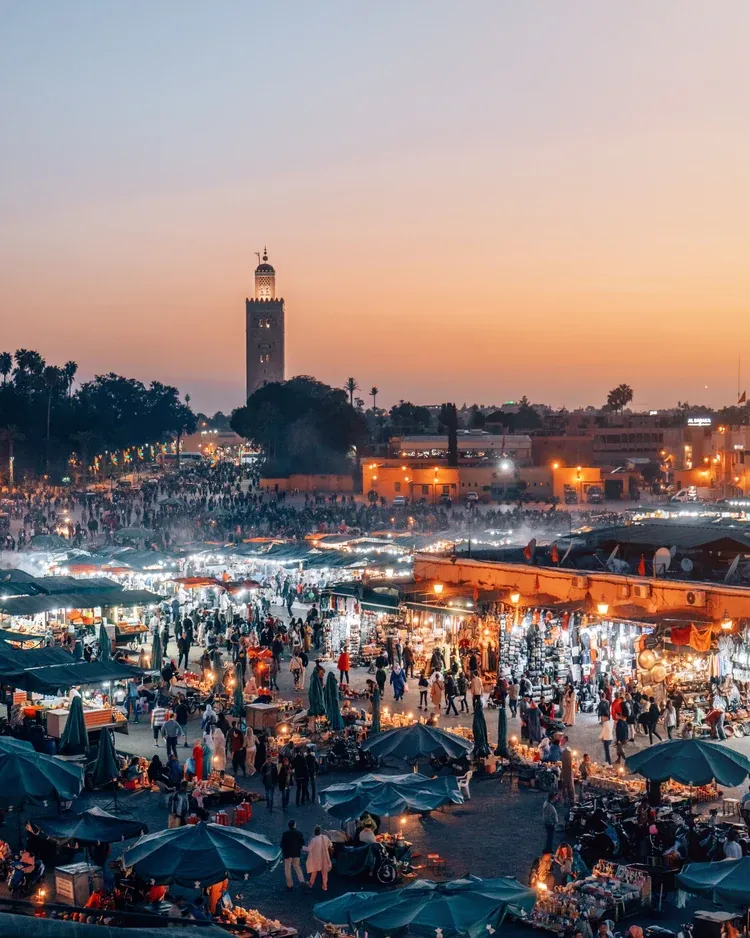
The triangular square at the heart of the medina is the stage of Marrakech life. By day it fills with orange juice carts, snake charmers and everyday trade; by night it becomes an open-air theatre of food stalls, musicians and storytellers on the same ground. UNESCO proclaimed the square's living tradition of oral performance a Masterpiece of Oral and Intangible Heritage in 2001, inscribing it on the Representative List in 2008. The Koutoubia minaret rises to the west, and Souk Semmarine begins to the north.
Location: heart of the medina, Marrakech
Access: Free to enter, day and night.
2. Koutoubia Mosque
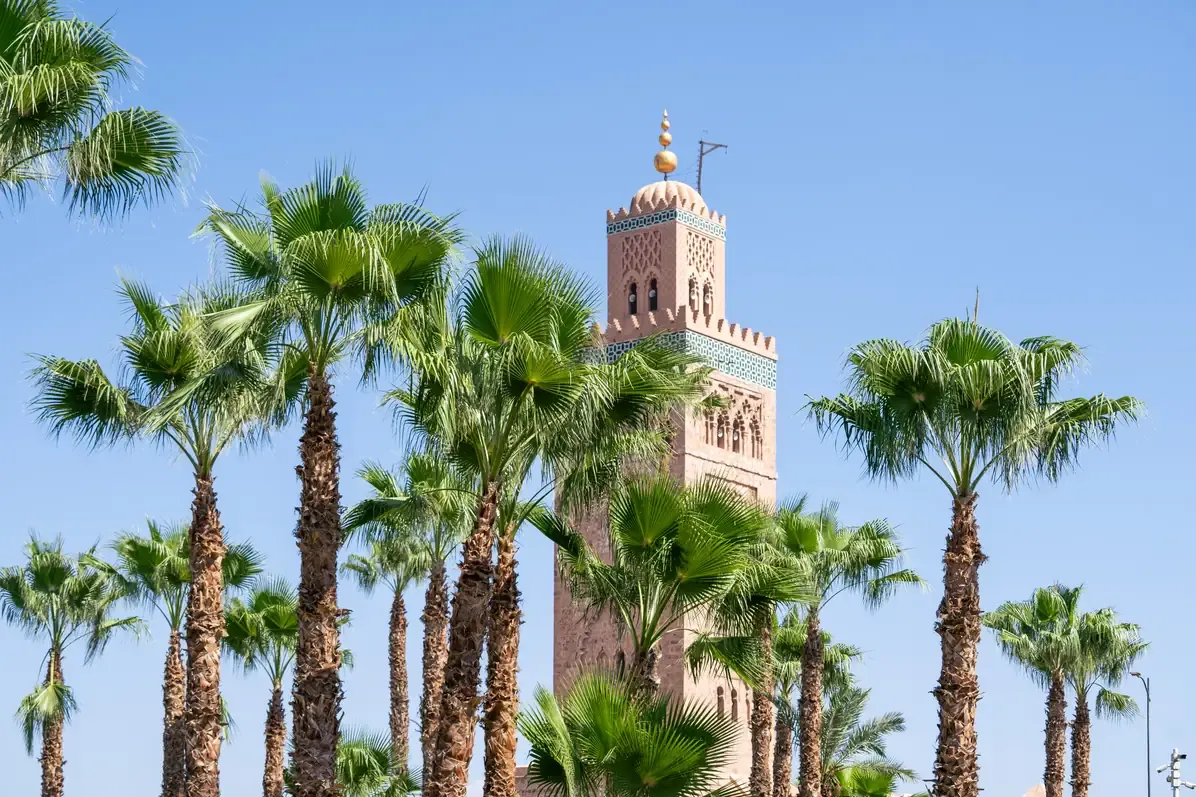
Marrakech's main mosque anchors the southwest edge of the medina with a stone minaret that UNESCO calls matchless, rising 77 metres above the palms. It set the model for Almohad minarets across the region in the 12th century. Non-Muslims do not enter the prayer hall, so the visit centres on the esplanade and the gardens that frame the minaret and give the walk into the medina a shaded start.
Style: Almohad (Moorish) architecture
Location: southwest edge of the medina, beside Jemaa el-Fnaa
Access: Free. The esplanade and gardens are open to all; the prayer hall is closed to non-Muslims.
3. Bahia Palace
Bahia Palace takes its name from a word meaning 'the brilliant', a nod to a favourite wife of the grand vizier who commissioned it. It grew from a chamberlain's house into an eight-hectare residence between 1894 and 1900, its four courtyards decorated with zellige, carved cedar and stucco, its salons opening onto fountains and lush gardens. The finest Moroccan craftsmanship in marble, moucharabieh and stained glass fills the rooms, and the palace later housed the French Resident General.
Style: Moorish architecture
Location: southern medina, near Place des Ferblantiers
Access: Ticketed, open daily.
Photos: "Bahia Palace large court" by Val Traveler, and two interior views by Draceane. All CC BY-SA 4.0.
4. El Badi Palace
Sultan Ahmad al-Mansur built El Badi Palace between 1578 and 1603 with gold, onyx and marble imported from Italy, a showpiece of Saadian ambition. Little of that opulence survives: today storks nest on its ruined ramparts above sunken gardens dug with reflecting pools, and visitors climb the walls for a wide view over the Kasbah and the Atlas Mountains beyond. The Saadian Tombs lie a short walk away within the same district.
Style: Saadian architecture
Location: Kasbah district, southern medina
Access: Ticketed, open daily.
Photos: three views of the El Badi Palace by Draceane (CC BY-SA 4.0).
5. Saadian Tombs
Hidden for centuries and rediscovered in 1917, this royal necropolis began in 1557 around the tomb of the dynasty's founder and grew when Sultan Ahmad al-Mansur buried his mother here in 1591. Its marble Hall of the Twelve Columns, where carved cedar and coloured stucco frame the graves of Saadian princes, is a showcase of the dynasty's craftsmanship. The tombs sit beside the Kasbah Mosque, reached down a narrow passage that kept them concealed for so long.
Style: Saadian architecture
Location: beside the Kasbah Mosque, southern medina
Access: Ticketed, open daily.
Photos: "Saadian Tombs" by C messier (CC BY-SA 4.0); "Innenhof der Saadier-Graber, Marrakesch" by Martin Furtschegger (CC BY 3.0).
6. Ben Youssef Madrasa
Once among the largest Quranic schools in Morocco, Ben Youssef Madrasa housed students in 134 small rooms set around a central courtyard of carved cedar, chiselled stucco and zellige tilework. Restored and reopened, the old college now works as a museum, its reflecting pool and geometric ornament among the most photographed sights in the medina. It stands in the Ben Youssef quarter north of the souks, near the Almoravid Koubba.
Style: Islamic architecture
Location: Ben Youssef quarter, northern medina
Access: Ticketed, open daily from 9:00 to 19:00.
Photos: "Medersa Ben Youssef" by Lundeux (CC BY-SA 2.5); "Ben Youssef Medersa, Marrakesh" by Michal Osmenda (CC BY-SA 2.0).
7. Jardin Majorelle
The painter Jacques Majorelle laid out this garden in the 1920s around a cobalt-blue studio villa, filling it with more than 300 plant species from five continents. Left to decline after his death, it was bought and revived by Yves Saint Laurent and Pierre Berge in 1980. The grounds also hold the Berber Museum, and the Musee Yves Saint Laurent stands next door, in the Gueliz district west of the medina.
Architect: Paul Sinoir (villa)
Location: Rue Yves Saint Laurent, Gueliz
Access: Ticketed, open daily.
Photos: "Le jardin Majorelle" by Viault; "Blue, green and pink" by Fati Zara Kh; "Jardin Majorelle, a fountain in a square basin" by Angeline A. van Achterberg. All CC BY-SA 4.0.
8. Le Jardin Secret
Le Jardin Secret reopened in 2016 after a four-year restoration of a 16th-century riad whose courtyards had stood derelict for decades. It divides into two gardens: an exotic garden gathering more than 3,000 plant species, and an Islamic garden planted only with species named in the Quran, laid around channels of running water. A tower rises above the walls for a view across the rooftops of the medina to the Atlas Mountains.
Location: Rue Mouassine, medina
Access: Ticketed, open daily.
Photos: two views of Le Jardin Secret by muffinn (CC BY 2.0); "Le Jardin Secret Marrakech" by Bernhard Holub (CC BY-SA 4.0).
9. Souk Semmarine
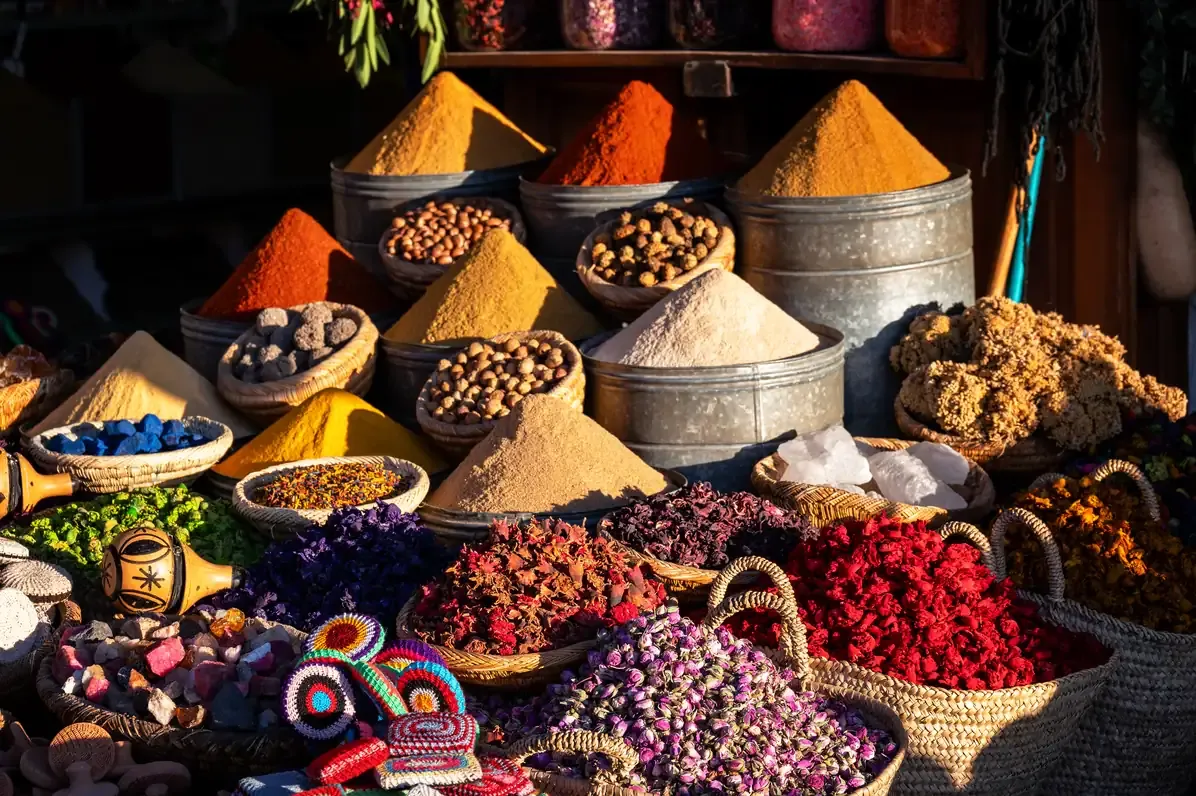
Marrakech's main market street runs north from Jemaa el-Fnaa under a covered lattice of reed and wood, its stalls stacked with leather, lanterns, spices and textiles. Side alleys branch into narrower souks, each once devoted to a single trade, from dyers to slipper makers and metalworkers. Wandering the lanes carries no obligation to buy; they are shaded through the day, busiest in the late morning and quieter first thing.
Location: north of Jemaa el-Fnaa, medina
Access: Free to walk. Individual stalls set their own hours.
Photo: "Covered Souk Semmarine, Marrakech" by DimiTalen (CC0 1.0).
10. Menara Gardens
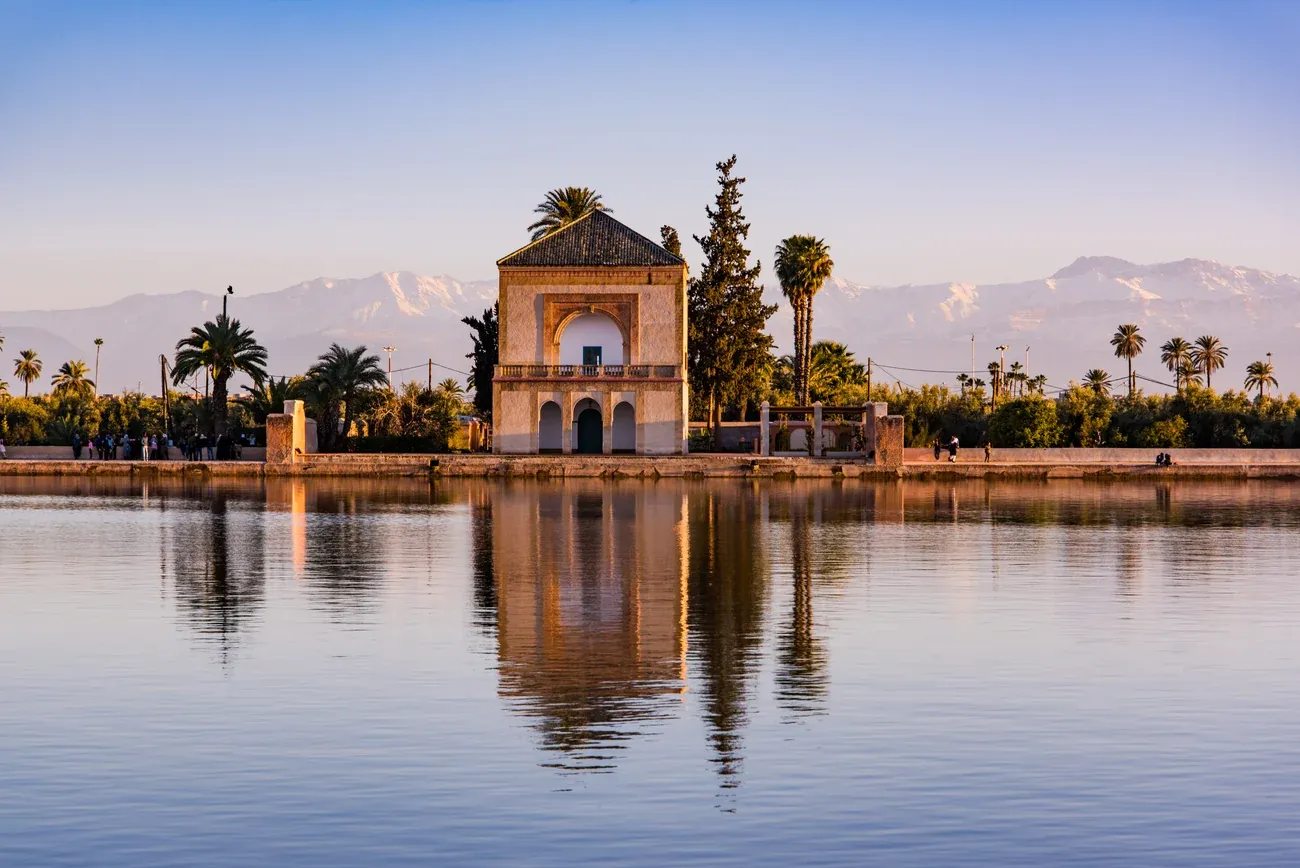
A pavilion built in the 16th century stands beside a large reflecting pool inside a 100-hectare olive grove that has faced the Atlas Mountains since the 12th century. Fed by a channel that carries snowmelt down from the peaks, the pool mirrors the pavilion and the mountains on still mornings, a scene long used as an emblem of the city. The grove spreads west of the medina, a quiet counterpoint to the density of the old town.
Location: west of the medina, off Avenue de la Menara
Access: Free to enter the grove. The pavilion overlooking the pool is a separate ticket.
Free landmarks and viewpoints in Marrakech
Bab Agnaou and the ramparts
Bab Agnaou and the more than 10 kilometres of ramparts, which Marrakech's tourism office dates to 1126 under the ruler Ali Ben Youssef, cost nothing to view or walk alongside, day or night.
Cyber Parc Arsat Moulay Abdeslam
This 8-hectare public garden opposite the Koutoubia is free to enter and draws more than 2 million visitors a year, with free WiFi hotspots that gave the park its name.
The Mellah and Place des Ferblantiers
The Mellah's lanes and Place des Ferblantiers, its tinsmiths' square, cost nothing to walk through between Bahia Palace and the Saadian Tombs, past the workshops that give the square its name.
Agdal Gardens
Agdal Gardens is free to visit but opens only on Friday, Saturday and Sunday, when its 500 hectares of Almohad-era olive groves and orchards, fed since the 12th century, welcome picnicking families.
What makes Marrakech worth visiting
Marrakech built its reputation on contrast: a walled red-ochre medina that has drawn caravans, sultans and merchants since its founding by the Almoravids in 1070-72 sits beside the palm groves and modern avenues of Gueliz. The Almohads and Saadians later filled the medina with the mosques, palaces and gardens that make up its UNESCO-listed old town, while Jemaa el-Fnaa keeps a tradition of storytelling and street performance UNESCO recognises separately as intangible heritage.
The medina and beyond
Within the ochre walls, the medina packs the Koutoubia, the souks and the palaces of the Kasbah into walkable lanes radiating from Jemaa el-Fnaa. Gueliz and Hivernage, the newer districts west of the medina, hold Jardin Majorelle, restaurants and hotels along wide boulevards. Further out, the Palmeraie and the Agdal and Menara gardens offer open space and mountain views without the density of the old town.
When to go and how long to stay
Spring and autumn bring the mildest weather for walking the medina, while summer heat can make midday sightseeing uncomfortable and winter evenings turn cool once the sun sets. Three to four days allow time for the medina's monuments, a garden or two and one excursion into the surrounding region, such as the Ourika Valley or the Ouzoud waterfalls, without rushing.
Getting around
The medina itself is walkable, its narrow lanes closed to most traffic, while calèches, petit taxis and a public bus connect it with Gueliz, the Palmeraie and Marrakech Menara Airport. Mopeds and bicycles cover longer hops between districts, and addresses inside the medina are best reached on foot or by asking for the nearest recognisable landmark. Marrakech was founded around 1070 by the Almoravids and its medina has been UNESCO listed since 1985, which keeps the city near the top of the must-see tourist attractions in Africa.