
Tourist attractions in Cairo
Known for
Ancient pyramids, an Islamic city and Pharaonic treasures
Must-see landmarks
Pyramids of Giza, Grand Egyptian Museum, and Citadel of Salah El-Din
Best time to visit
October to April, once summer's extreme heat eases
World Heritage
Historic Cairo, UNESCO World Heritage listed since 1979
Cairo's top 10 tourist attractions
Cairo's tourist attractions start with Pyramids of Giza and the Great Sphinx, Grand Egyptian Museum and Egyptian Museum (Tahrir Square). The 10 top sights are ranked below, followed by visitor FAQs.
1. Pyramids of Giza and the Great Sphinx
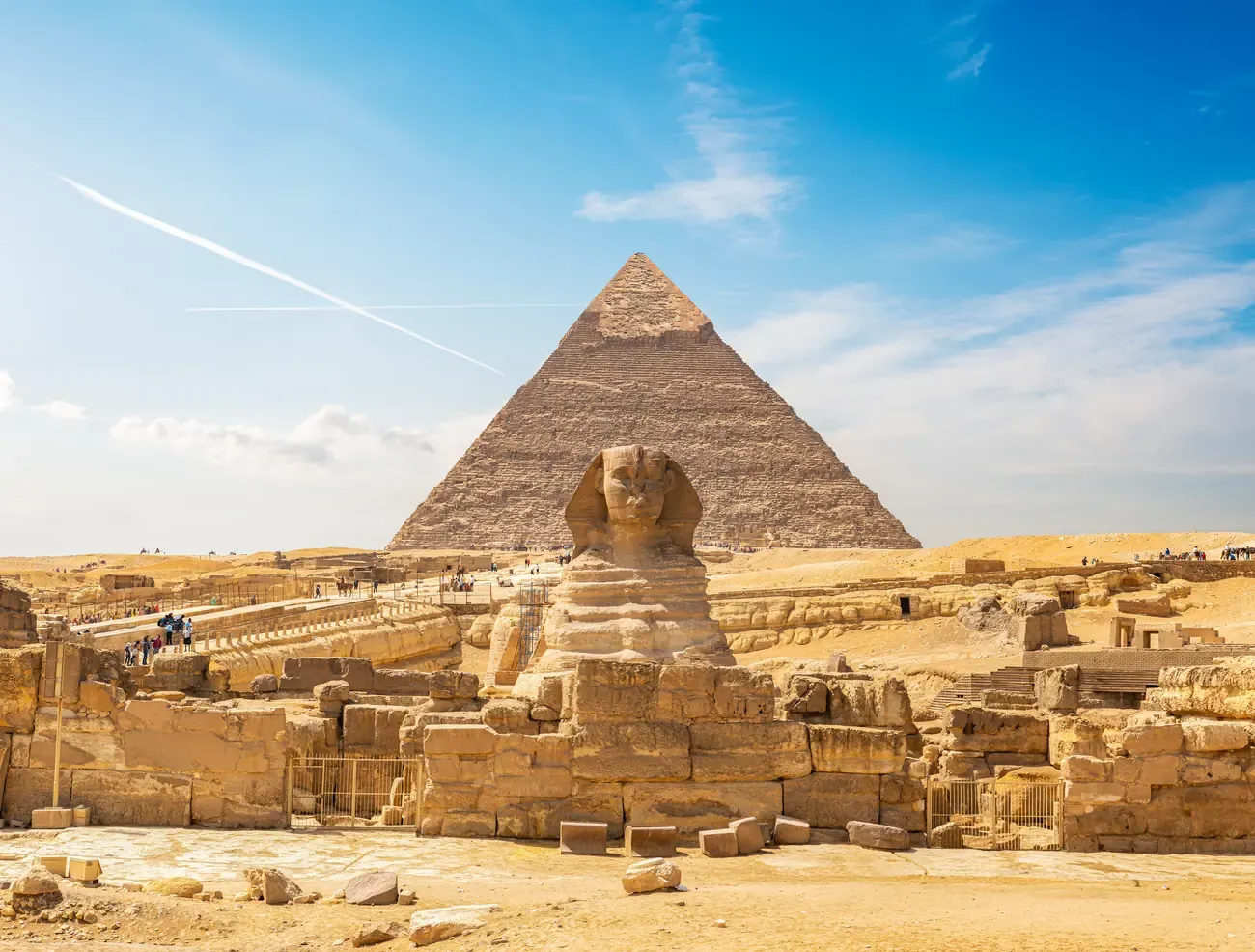
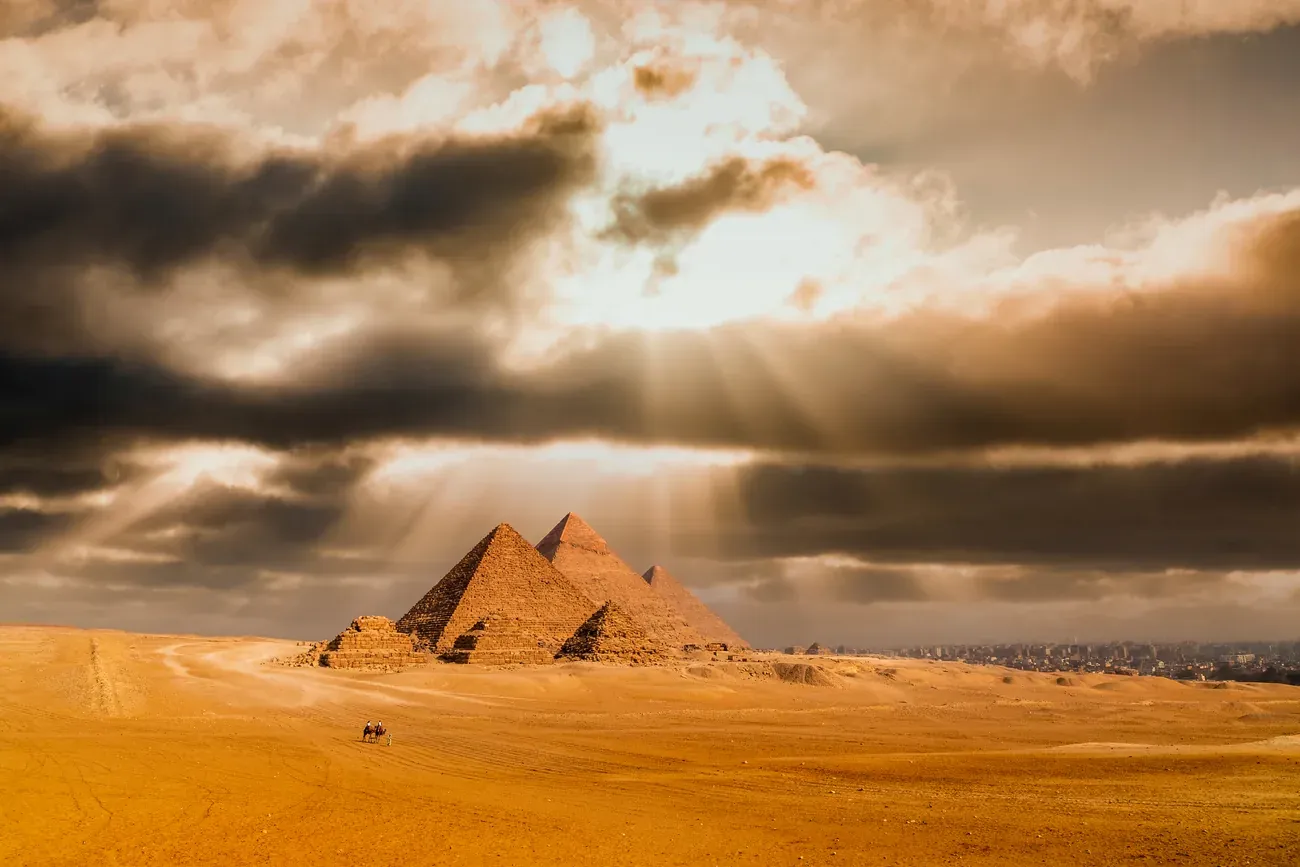
On the city's western edge the Giza plateau carries the last surviving wonder of the ancient world, the Great Pyramid of Khufu, raised around 2589 to 2566 BC and for millennia the tallest structure ever built. Beside it stand the pyramids of his son Khafre and grandson Menkaure, and below them the Great Sphinx, a lion-bodied guardian carved from a single outcrop of rock. Electric shuttle buses cross the sand between the pyramids and the Sphinx, and the plateau looks straight across to the Grand Egyptian Museum.
Built: around 2560 BC
Location: Giza plateau, western Cairo
Access: Ticketed, with the plateau open daily from 08:00 to 16:00; separate tickets cover entry inside the pyramids.
2. Grand Egyptian Museum
Opened in 2025 on the edge of the Giza plateau, the Grand Egyptian Museum was built to gather Egypt's pharaonic treasures under one roof within sight of the pyramids. A grand staircase lined with royal statues climbs toward a wall of glass that frames the pyramids beyond, while the Tutankhamun galleries bring together the complete contents of the boy king's tomb, shown as one collection for the first time since its discovery in 1922. A colossus of Ramesses II greets visitors in the entrance hall.
Architect: Heneghan Peng · Opened: 2025
Location: Giza plateau, Cairo
Access: Timed entry, with tickets booked for a set arrival slot.
3. Egyptian Museum (Tahrir Square)
The domed museum on Tahrir Square opened in 1902 and remains the historic home of Egyptian archaeology, its crowded halls tracing pharaonic art from the Old Kingdom to the Greco-Roman age. Among its best known pieces are the Narmer Palette, which records the union of Upper and Lower Egypt, and the Old Kingdom statues of Khufu, Khafre and Menkaure. Many royal mummies and the Tutankhamun treasures have moved to newer museums, yet tens of thousands of objects still fill its galleries.
Opened: 1902
Location: Tahrir Square, Downtown Cairo
Access: Ticketed, open daily.
4. Citadel of Saladin and the Mosque of Muhammad Ali
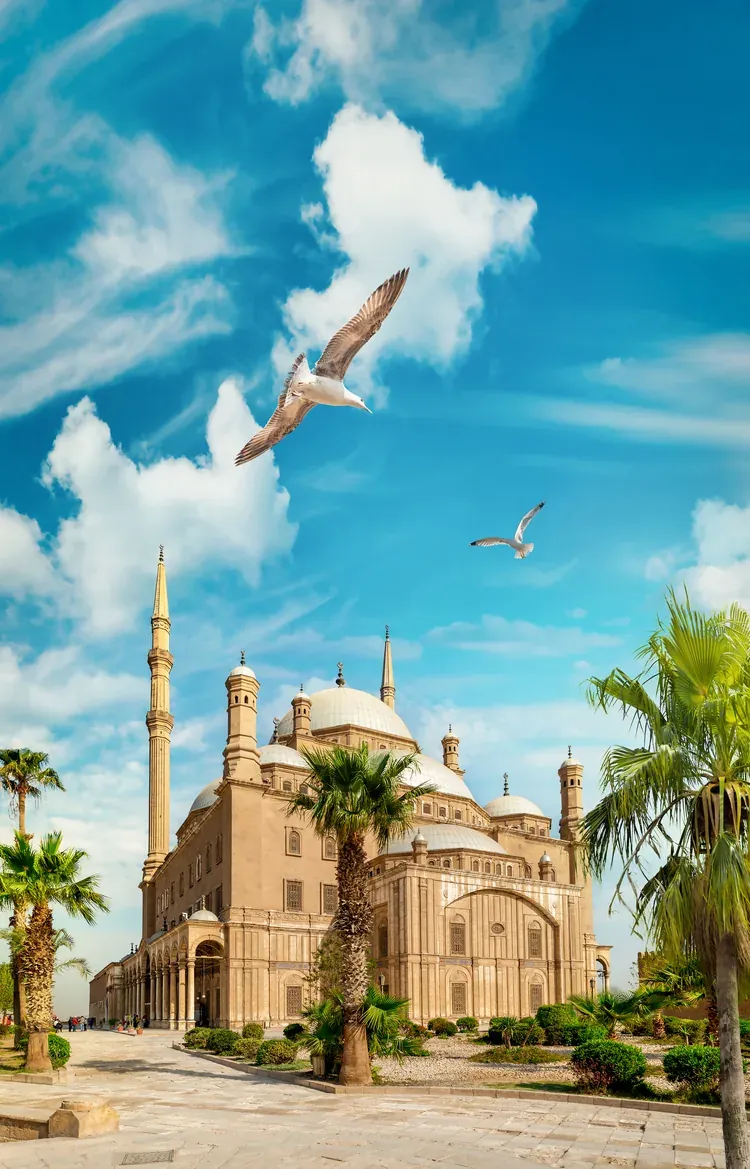
Salah El-Din, the Saladin of the Crusades, began this hilltop fortress in 1176, and it served as the seat of Egypt's rulers for some seven hundred years. Its walls look out over the whole city, and within them rises the Mosque of Muhammad Ali, built in the first half of the nineteenth century and lined inside and out with pale alabaster that gives it its nickname. Its twin minarets, at 84 metres the tallest in Egypt, are a landmark on the skyline.
Built: fortress begun 1176; mosque completed 1848
Location: Salah Salem Street, Islamic Cairo
Access: Ticketed, with the mosque and the citadel grounds included.
5. Khan el-Khalili and Al-Muizz Street
Cairo's great medieval bazaar has traded from this warren of covered lanes since the fourteenth century, its stalls packed with lanterns, spices, silver and glassware. The souk spills onto Al-Muizz li-Din Allah Street, the old Fatimid spine of the walled city that runs between the northern gate of Bab al-Futuh and the southern gate of Bab Zuwayla, past a dense run of mosques, madrasas and merchant houses that UNESCO counts among the monuments of Historic Cairo. Coppersmiths and coffee houses still work the alleys after dark.
Founded: 14th century
Location: Al-Muizz Street, Islamic Cairo
Access: Free to wander; only what is bought at the stalls carries a price.
6. Al-Azhar Mosque
Commissioned in 970, soon after the Fatimids founded their new capital, Al-Azhar was Cairo's first congregational mosque and grew into one of the oldest universities in the world and a leading centre of Sunni learning. Its wide marble courtyard is ringed by arcades that mix Fatimid, Mamluk and Ottoman work, and a cluster of minarets from different centuries rises above it, part of the skyline that earned Cairo its old name, the City of a Thousand Minarets. Students still gather in its arcades.
Style: Fatimid · Founded: 970
Location: Al-Azhar Street, Islamic Cairo
Access: Free to enter outside prayer times; modest dress is required.
7. Mosque of Ibn Tulun
One of the oldest mosques in Egypt to survive in its original form, Ibn Tulun was raised between 876 and 879 for the Abbasid governor who briefly made Cairo the seat of his own dynasty. Built of red brick faced in carved stucco, it is laid out around a vast open courtyard, one of the largest of any mosque in the city, with a domed ablution fountain at its heart. Its outer spiral minaret, climbed by an external staircase, echoes the great mosque of Samarra in Iraq.
Style: Abbasid · Built: 876 to 879
Location: Sayyida Zaynab, Cairo
Access: Free to enter; a small tip for the shoe custodian is customary.
8. Sultan Hassan and Al-Rifai Mosques
Two great mosques face each other across Salah El-Din Square below the Citadel. The Mosque-Madrasa of Sultan Hassan, built between 1356 and 1362, is a masterpiece of Mamluk architecture on a colossal scale, its soaring gateway and cross-shaped court once housing schools for all four Sunni traditions of law. Opposite stands the Al-Rifai Mosque, begun in the 1860s and finished in 1912 in a style that echoes its medieval neighbour, its marble halls holding the tombs of the royal family of Muhammad Ali and the last shah of Iran.
Style: Mamluk · Built: Sultan Hassan 1356 to 1362
Location: Salah El-Din Square, Islamic Cairo
Access: Ticketed, with one ticket covering both mosques.
9. Coptic Cairo and the Hanging Church
Old Cairo, on the site of the Roman fortress of Babylon, gathers the city's oldest churches, a synagogue and the Coptic Museum nearby. Its most famous monument is the Hanging Church, so called because its nave was built over a gatehouse of the Roman fort, leaving it suspended above the gate. Behind a carved twin-towered facade, its timber ceiling is shaped like the hull of Noah's Ark, and a marble pulpit rests on slender columns above rows of old icons.
Built: rebuilt from the 7th century
Location: Mar Girgis Street, Coptic Cairo
Access: Free to enter the churches; the Coptic Museum charges separate admission.
Photo: "Hanging Church from the courtyard" by Daniel Mayer (CC BY-SA 4.0).
10. Cairo Tower
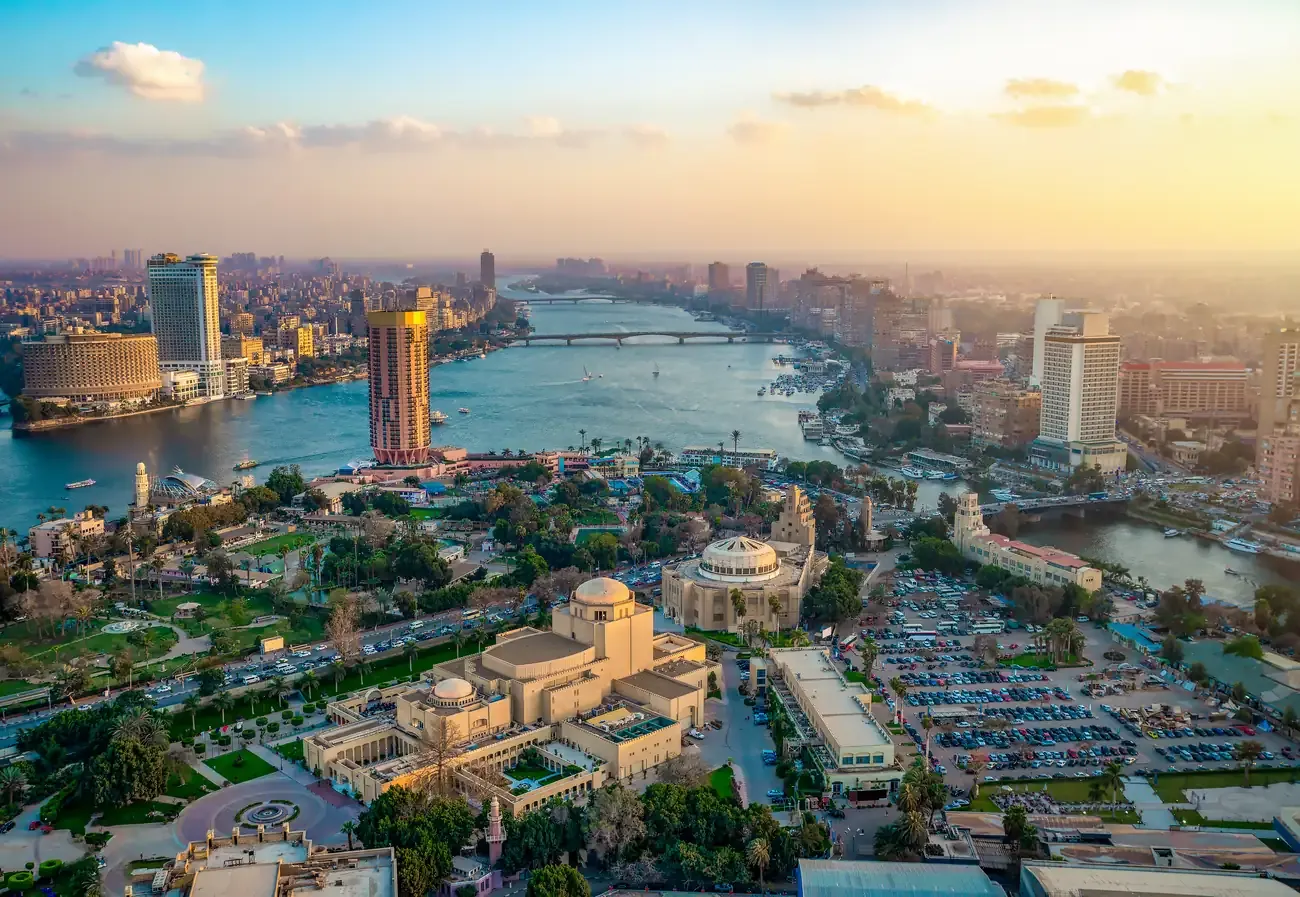
Rising from Gezira Island in Zamalek, the Cairo Tower has stood over the river since it opened in 1961, a slender concrete shaft of 187 metres wrapped in a latticework screen shaped like a lotus plant. An observation deck near the top gives an open view across the whole city, from the Nile and its bridges to the distant pyramids on clear days, while a revolving restaurant turns slowly a few floors below. Designed by the engineer Naoum Shebib, it remains one of Cairo's defining modern landmarks.
Architect: Naoum Shebib · Opened: 1961
Location: Gezira Island, Zamalek, Cairo
Access: Ticketed, with timed slots for the observation deck at busy times.
What makes Cairo special
Historic Cairo grew from the Fatimid capital that the general Gawhar al-Siqilli founded in 969, a walled city of mosques, madrasas and covered markets that UNESCO counts among the world's oldest Islamic urban centres still standing. Layers of Fatimid, Ayyubid, Mamluk and Ottoman building sit side by side across its old quarters, while the pyramids on the city's edge and the churches of Old Cairo add millennia more history to a single day's walk.
Neighbourhoods to know
Islamic Cairo, inside the old Fatimid walls, holds the densest run of medieval mosques and markets. Old Cairo, further south along the Nile, gathers the Coptic churches and the remains of the Roman fortress of Babylon. Downtown's early 20th century boulevards fan out from Tahrir Square, while Zamalek and Giza, on opposite banks of the Nile, hold quieter gardens and the pyramids themselves.
When to go and for how long
Winter, from October to April, brings much easier walking weather for the old city and the plateau at Giza, once summer's extreme heat eases. Three to four days cover the pyramids, the Grand Egyptian Museum, Islamic Cairo and the Egyptian Museum at a steady pace, with a fifth day free for Saqqara and Dahshur, around 30 and 40 kilometres south, or further to the Roman and Greek ruins of Alexandria, around 220 kilometres north on the Mediterranean coast.
Getting around
Three Cairo Metro lines cross the city, with some cars reserved for women, alongside a dense network of taxis and ride-hailing apps that cover the ground the metro does not reach. Central Cairo suits walking in short stretches, while Giza and Islamic Cairo, split by the Nile and several kilometres of traffic, are best joined by taxi or the shuttle now running across the pyramids plateau. The Giza plateau, the Grand Egyptian Museum beside it and the Egyptian Museum on Tahrir Square are the capital's entries among tourist attractions in Egypt, a list that runs on south to the temples of Luxor and Aswan.