
Tourist attractions in Chiang Mai
Known for
Buddhist temples, markets and Lanna culture in the northern Thailand
Must-see landmarks
Wat Phra Singh, Wat Chedi Luang, and Wat Phra That Doi Suthep
Best time to visit
November to February, the cool and dry season
Free to visit
Phae Gate, Old City's moat, most temple grounds, and Warorot Market
Top 10 tourist attractions in Chiang Mai
For a first visit, the tourist attractions in Chiang Mai come down to Wat Phra That Doi Suthep, Wat Phra Singh, Wat Chedi Luang and 7 more sights ranked below, plus free things to do and visitor FAQs.
1. Wat Phra That Doi Suthep
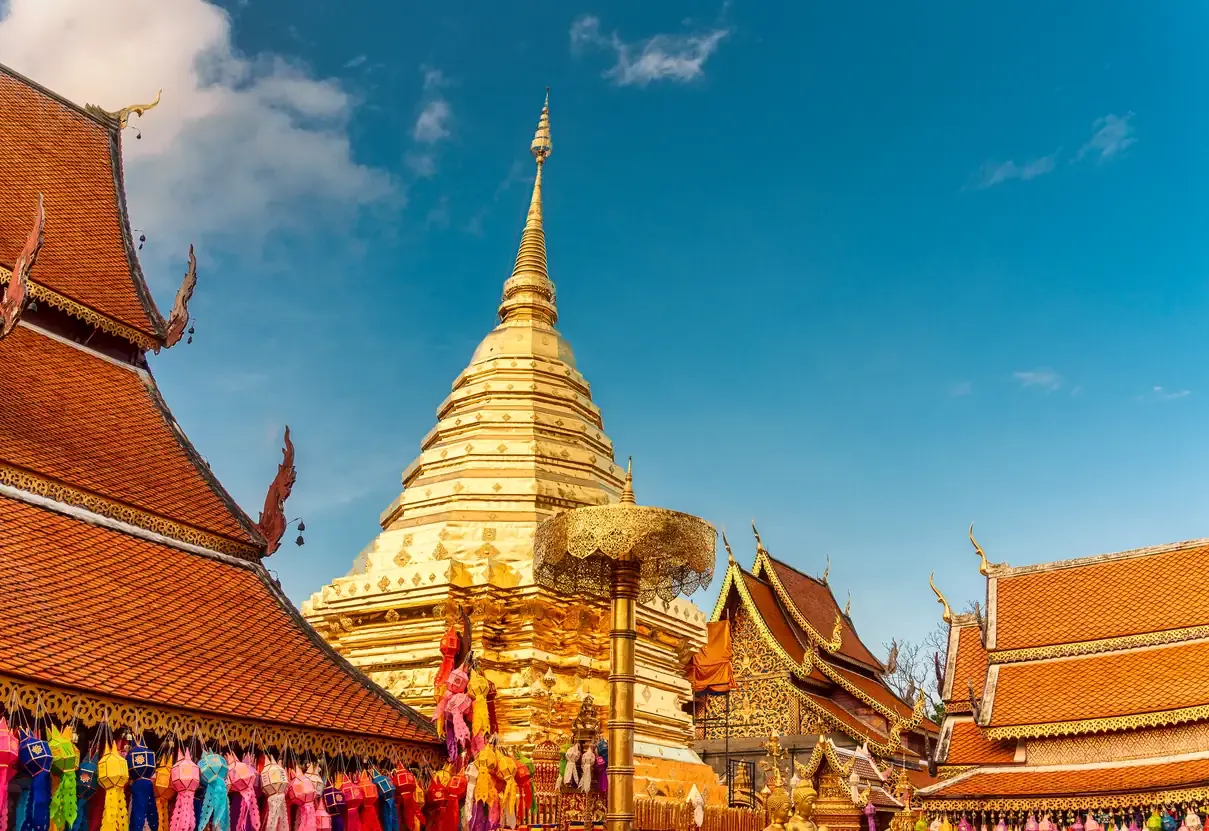
Chiang Mai's signature temple crowns Doi Suthep mountain about fifteen kilometres above the city, its golden chedi rising over a terrace that looks across the whole valley. Legend traces its founding to 1383, marking where a relic-bearing white elephant is said to have died, and today a naga-flanked staircase of more than three hundred steps and a small funicular both climb to the summit shrine. Ringed by bells and tiered umbrellas, the gilded chedi is the image most associated with the city.
Location: Suthep, Mueang Chiang Mai District, Chiang Mai
Access: Ticketed, with a small admission for foreign visitors to the upper terrace; the funicular and the naga staircase both reach the shrine.
2. Wat Phra Singh
One of the Old City's most revered temples began in 1345, when King Phayu built it to hold his father's ashes and first called it Wat Lee Chiang Phra. It took its present name after receiving the Phra Buddha Sihing image, still enshrined in the gold-leafed Lai Kham chapel completed between 1815 and 1821. Wandering the walled grounds, with their teak scripture library and Lanna-style viharns, costs nothing, though a small charge applies inside the hall that keeps the temple's namesake figure.
Founded: 1345
Location: Samlan Road, Phra Singh, Mueang Chiang Mai District, Chiang Mai
Access: Free to wander the grounds; a small fee applies inside the main hall.
3. Wat Chedi Luang
King Saen Muang Ma began this vast chedi in 1391 to house his father's ashes, and it grew into one of the largest structures in the Lanna kingdom before a 1545 earthquake brought down its upper section, which was never rebuilt. The weathered brick core still towers over the Old City, guarded by stone elephants and naga staircases. Sao Inthakin, the city's guardian pillar shrine, has stood in the grounds since King Kawila moved it here in 1800.
Founded: 1391
Location: Prapokkloa Road, Phra Singh, Mueang Chiang Mai District, Chiang Mai
Access: Ticketed, with a small admission for foreign visitors; Thai nationals enter free.
4. Wat Chiang Man
Chiang Mai's oldest temple began as King Mengrai's residence while the new capital's walls rose around it in the 1290s. Its Chedi Chang Lom is ringed at the base by rows of brick and stucco elephants, and the main hall keeps two of the city's most revered images, the small carved stone Phra Sila and the crystal Phra Sae Tang Khamani. Quieter than the temples nearby, its shaded courtyard makes an easy first stop inside the moat.
Founded: 1290s
Location: Ratchaphakhinai Road, Si Phum, Mueang Chiang Mai District, Chiang Mai
Access: Free to enter.
5. Tha Phae Gate
The best known of the Old City's gates was first raised by King Mengrai in 1296 as the walled town's eastern entrance, and today's brick structure is a 1985 to 1987 reconstruction by the Chiang Mai Municipality and the Fine Arts Department, rebuilt from old photographs. Its wide plaza is the city's gathering place, filling with crowds for Songkran and the Yi Peng lantern festival and marking the start of the Sunday Walking Street. Pigeons, buskers and photographers fill it through the day.
Founded: 1296
Location: Tha Phae Road, Si Phum, Mueang Chiang Mai District, Chiang Mai
Access: Free, an open public plaza at all hours.
6. Three Kings Monument
Three bronze figures stand at the heart of the Old City, showing Kings Mengrai, Ramkhamhaeng and Ngam Muang, the rulers honoured as founders of Chiang Mai. Cast by the artist Kaimook Chuto and unveiled in 1984, the statues face the former provincial hall that now holds the Chiang Mai City Arts and Cultural Centre and the Lanna Folklife Museum. The open square around them hosts Songkran and Loi Krathong processions and draws a steady stream of offerings.
Unveiled: 1984
Location: Prapokkloa Road, Si Phum, Mueang Chiang Mai District, Chiang Mai
Access: Free to see at any hour; the two museums facing it charge admission separately.
7. Warorot Market
Known locally as Kad Luang, one of the north's largest markets took its present form in 1910, when Princess Dara Rasmi transformed the site, once a royal funeral ground, and named it for an early Chiang Mai ruler. Textiles, dried goods and northern snacks fill the upper floors above ground-level food stalls, while flowers and fresh produce spill toward the Ping River end. The lanes stay busiest early in the morning, when locals come to shop and eat.
Founded: 1910
Location: Wichayanon Road, Chang Moi, Mueang Chiang Mai District, Chiang Mai
Access: Free to wander; only what is bought at the stalls carries a price.
Photos: the market interior and its food stalls by Christophe95 (CC BY-SA 4.0).
8. Wat Umong
This forest temple at the foot of Doi Suthep was established in the late thirteenth century and is unlike any other in the city, built around a mound of ancient brick tunnels whose arched passages are lined with faded murals and small Buddha images. Moss covers the old walls, and the wooded grounds, dotted with a chedi, a pond and meditation quarters, stay far quieter than the temples inside the Old City. It remains an active centre for meditation and forest-dwelling monks.
Founded: late 13th century
Location: Suthep, Mueang Chiang Mai District, Chiang Mai
Access: Free to enter; donations support the temple.
Photos: the ancient brick tunnels of Wat Umong by Chainwit. (CC BY 4.0).
9. Doi Inthanon (day trip)
A day's drive southwest of the city, this national park protects Thailand's highest peak, a 2,565 metre summit reachable by road. Twin royal pagodas built in 1987 and 1992 stand on a ridge below the top, set in gardens with wide views over misty valleys, while cloud forest trails, waterfalls and rich birdlife draw walkers up the higher slopes. Mornings in the cool season bring the clearest air before the haze.
Park established: 1972
Location: Doi Inthanon National Park, Chom Thong District, about 60 kilometres southwest of Chiang Mai
Access: Ticketed park entry for foreign visitors, with a separate charge for the twin pagodas; open daily.
Photo: the mountains of Doi Inthanon by Vyacheslav Argenberg (CC BY 4.0).
10. Elephant Nature Park (day trip)
In the hills north of the city, this sanctuary rescues elephants from riding camps, logging and street begging, and describes itself as the first ethical elephant refuge of its kind in Asia. Riding is banned entirely; visitors instead walk with the resident herd, watch them roam the valley and help prepare their food, while longer stays let guests join the daily care of the animals. The visit centres on observing the elephants rather than performing with them.
Location: Kuet Chang, Mae Taeng District, in the hills north of Chiang Mai
Access: Ticketed day and overnight programs by advance booking; no elephant riding.
Photo: rescued elephants and a mahout by AngelB00709620 (CC BY-SA 4.0).
Free attractions to visit in Chiang Mai
Sunday Walking Street
Browsing the stalls along Ratchadamnoen Road on Sunday evening costs nothing beyond what gets bought; only the food and crafts on sale carry a price.
Wat Pha Lat and the Monk's Trail
A shaded dirt path climbs from the western edge of the city through the forest to Wat Pha Lat, a rest stop for pilgrims climbing to Doi Suthep since 1355 and revived from near abandonment in 1991. Both the trail and the temple are free to visit, without the crowds at the summit above.
Wat Lok Moli
Just north of the moat, this temple's un-restored brick chedi and quiet gardens cost nothing to visit and see a fraction of the Old City's temple crowds.
Buak Hard Public Park
This free public park in the Old City's southwest corner has ponds, fountains and shaded paths, with free outdoor exercise equipment and space to walk or jog.
Why Chiang Mai deserves your time
Chiang Mai became the capital of the Lanna Kingdom in 1296, when King Mengrai chose a site between the Ping River and Doi Suthep mountain and enclosed it with the square moat and walls that still outline the Old City today. Lanna kept its own kings for centuries before Siam absorbed it, and the temples, script and cuisine that developed under them still set the city apart from Bangkok. Doi Suthep on the mountain above town and the White Temple at Chiang Rai are the northern entries in most accounts of the tourist attractions in Thailand, and khao soi comes from the same Lanna kitchen.
Neighbourhoods to know
Old City temples fill the moated square at the centre, still the base for most first visits. Nimmanhaemin, west toward Chiang Mai University, holds the city's cafe and gallery scene, while the streets east of the moat around Warorot Market and the Night Bazaar keep the trading city's older commercial pulse. Mae Rim and the mountains north and west, reached by road, hold Doi Suthep, elephant sanctuaries and waterfalls.
When to go and for how long
November to February brings the coolest, driest weather and the clearest mountain views, while the burning season from February to April fills the valley with smoke haze from crop fires and pushes temperatures toward 40°C by April. Three to four days cover the Old City, Doi Suthep and a day trip into the surrounding hills at a comfortable pace.
Getting around
The Old City is compact enough to walk between temples, and red songthaew pickup trucks alongside ride-hailing apps such as Grab cover the rest of the city and the roads up to Doi Suthep and Nimmanhaemin easily enough that few visitors bother renting a car.