
San Francisco tourist attractions
Known for
Steep hills, cable cars and the Golden Gate Bridge
Must-see landmarks
Golden Gate Bridge, Alcatraz Island, Pier 39 and Golden Gate Park
Best time to visit
September and October, the warmest and driest months
Days needed
3 to 4 days to cover downtown, the waterfront and Golden Gate Park
The 10 tourist attractions to see in San Francisco
San Francisco's tourist attractions start with Golden Gate Bridge, Alcatraz Island and Fisherman's Wharf and Pier 39. The 10 top sights are ranked below, followed by free things to do, upcoming events and visitor FAQs.
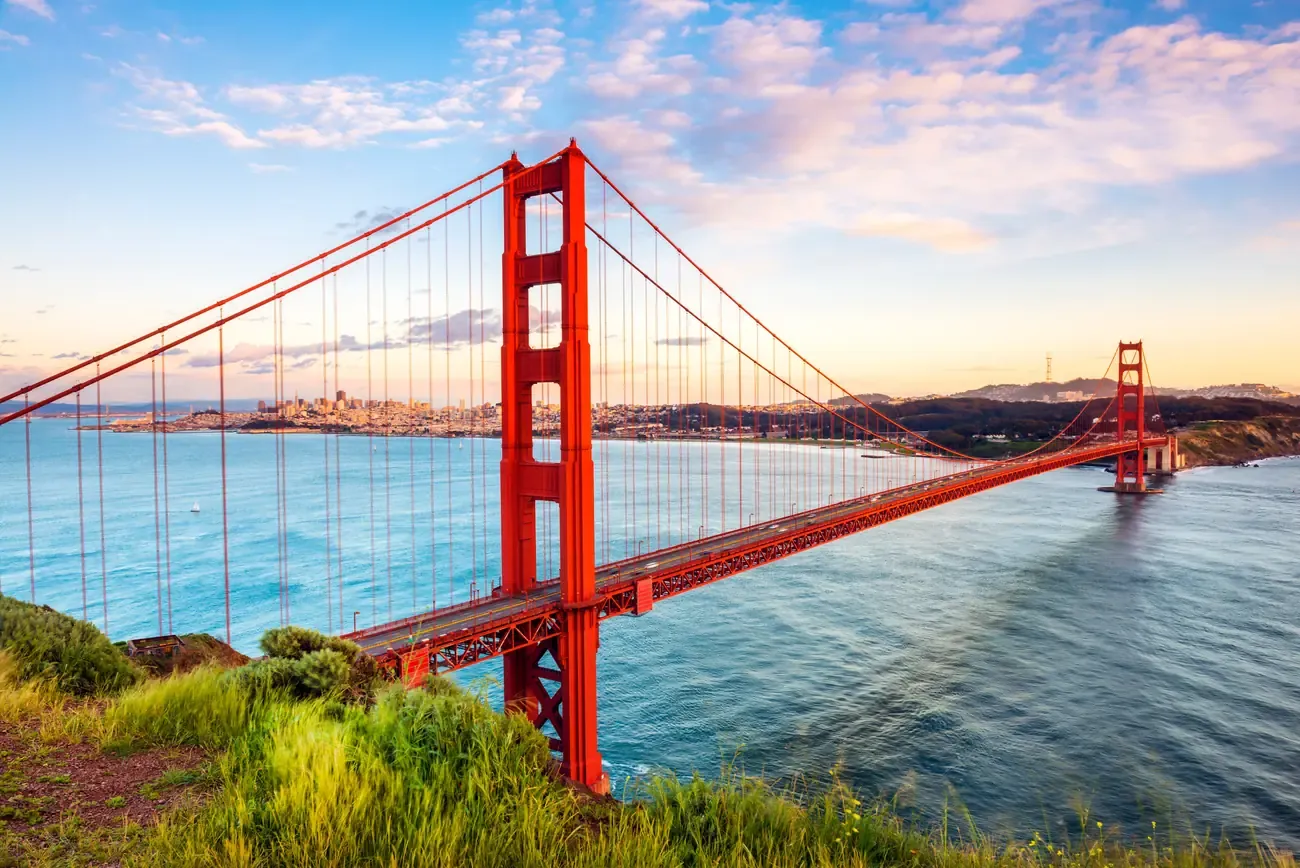
1. Golden Gate Bridge
The Golden Gate Bridge spans the strait where San Francisco Bay meets the Pacific, its International Orange towers rising above the fog that often drifts through the gate. Opened in 1937 to a design led by Joseph Strauss, its 4,200 foot main span held the record for the world's longest suspension bridge until 1964. Walking or cycling across the east sidewalk is one of the city's classic free outings, the skyline on one side and the Marin headlands on the other.
Architect: Joseph Strauss · Opened: 1937
Location: US-101 across the Golden Gate strait, San Francisco
Access: Free to cross on foot or by bike; the east sidewalk opens at 05:00, closing at 18:30 in winter and 21:00 in summer. Sidewalk hours on the official site.
2. Alcatraz Island
Ringed by cold bay currents, Alcatraz held federal prisoners including Al Capone until the penitentiary closed in 1963, having earlier served as a military fort and the site of a nineteenth century lighthouse. The National Park Service now runs the island within the Golden Gate National Recreation Area, with a cell house audio tour, the parade ground and wide views back to the city skyline. A 1969 occupation by Native American activists left its own mark on the island's story.
Location: San Francisco Bay; ferries depart Pier 33 on The Embarcadero
Access: Ticketed, with all landings run by the National Park Service concessionaire Alcatraz City Cruises; sailings are best booked well ahead.
3. Fisherman's Wharf and Pier 39
The northern waterfront strings together Fisherman's Wharf and Pier 39, where wild California sea lions have hauled out on the K-Dock since shortly after the 1989 Loma Prieta earthquake. Street performers work the plazas, historic ships and seafood counters line the piers, and the double-decked Pier 39 carries shops, a carousel and an aquarium out over the water. Watching the sea lions bark and jostle costs nothing, and the promenade gives long views to Alcatraz and the bridge.
Location: Beach Street and The Embarcadero, Fisherman's Wharf, San Francisco
Access: Free to walk the wharf and watch the sea lions; the aquarium, carousel and bay cruises are ticketed.
Photos: "Fisherman's wharf, Pier 39, San Francisco" by Carol M. Highsmith (Public domain); "Pier 39 (San Francisco)" by Yelderberry (CC BY-SA 4.0); and "Fisherman's Wharf, San Francisco" by Jana Taylor (CC BY-SA 3.0).
4. Golden Gate Park
Laid out from the 1870s on former sand dunes reaching almost to the Pacific, Golden Gate Park is San Francisco's great green rectangle of meadows, lakes and wooded paths. Within the grounds sit the California Academy of Sciences, with its aquarium, planetarium and rainforest dome under a living roof, the de Young art museum and a formal Japanese Tea Garden. Windmills, a domed conservatory of flowers and a small bison paddock are scattered among the trees.
Architect: William Hammond Hall and John McLaren · Opened: 1870
Location: Between Stanyan Street and Ocean Beach, San Francisco
Access: Free to enter and open daily; the Academy of Sciences, de Young and Japanese Tea Garden each charge separate admission. Park information on the official site.
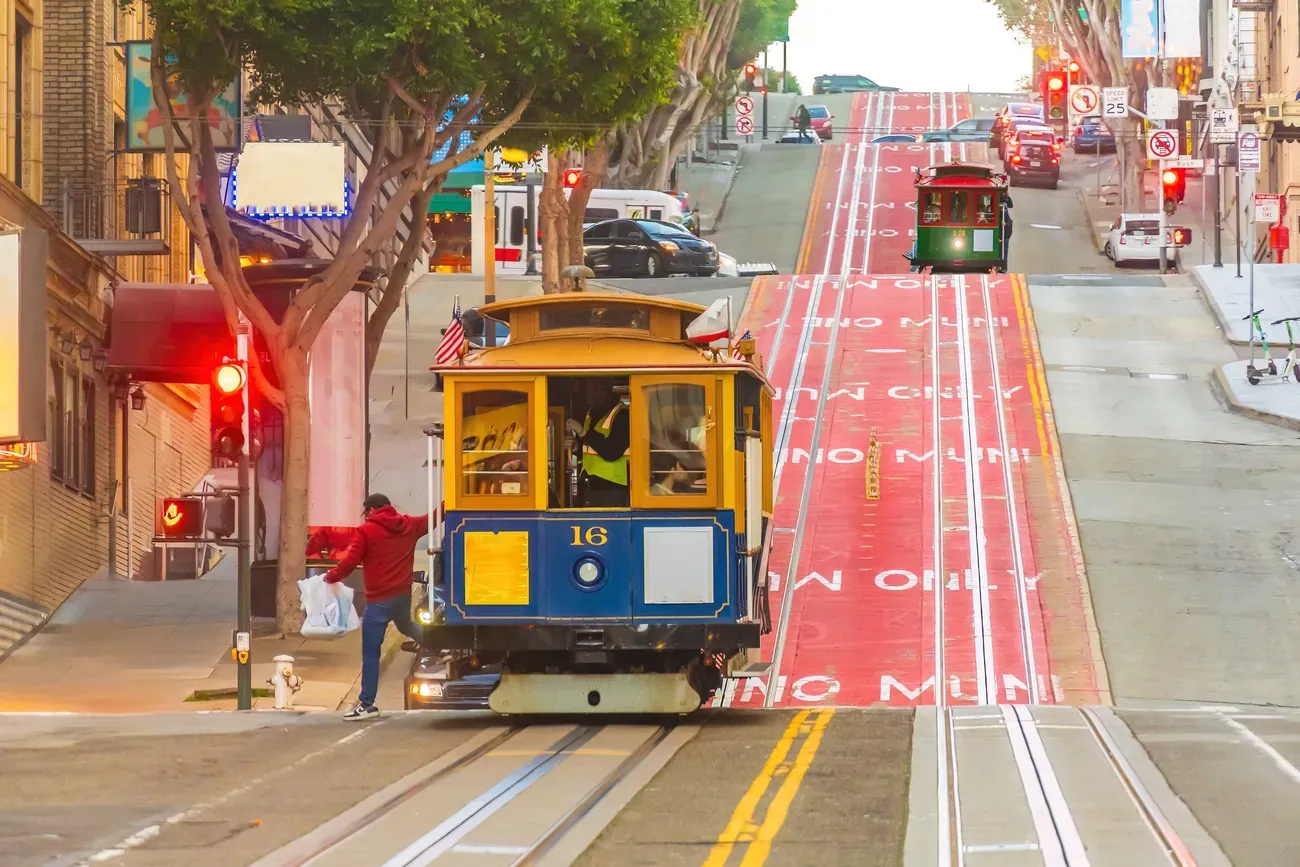
5. San Francisco Cable Cars
The world's last manually operated cable car system has climbed San Francisco's hills since the 1870s, gripping a continuously moving cable set beneath the street. Three lines survive as working transport rather than a museum piece: the Powell-Hyde and Powell-Mason routes run between the downtown turntable at Powell and Market and the northern waterfront, while the California Street line crosses Nob Hill. At the Powell Street turnaround, crews still rotate the historic cars by hand.
Location: Powell-Hyde, Powell-Mason and California Street lines, San Francisco
Access: Ticketed to ride, operated by the San Francisco Municipal Transportation Agency; a single-ride ticket or a Muni day pass covers the fare.
Photos: "Cable car 19 on Hyde Street" by Pi.1415926535 and "Cable Car No. 15, Powell Market turntable, San Francisco" by JCruzTheTruth, both CC BY-SA 4.0.
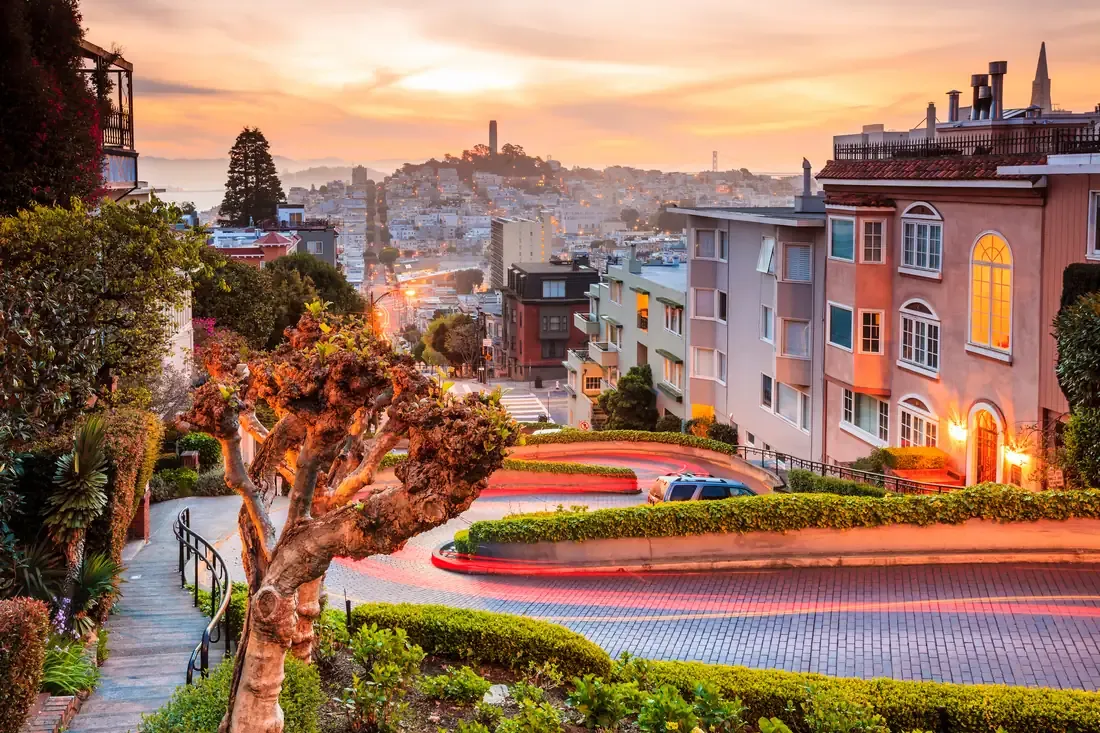
6. Lombard Street
The 1000 block of Lombard Street on Russian Hill switchbacks down the slope in eight tight curves, planted with hydrangeas and paved in red brick. Property owners engineered the one-block zigzag in the 1920s to tame a grade too steep for most cars, and it has been photographed ever since as the crookedest street in the world, though the city notes the technical title belongs to Vermont Street on Potrero Hill. The climb rewards walkers with views over North Beach and the bay.
Location: Lombard Street between Hyde and Leavenworth, Russian Hill, San Francisco
Access: Free to walk or drive down at any hour; the crooked block is a public street.
Photos: "Lombard Street, San Francisco" by peterlaster (CC0); and "Lombard Street, San Francisco, 2022" by dconvertini (CC BY-SA 2.0).
7. Palace of Fine Arts
Bernard Maybeck's Palace of Fine Arts rises beside a lagoon in the Marina District, an open rotunda and colonnade in a weathered Beaux-Arts style modelled on Roman and Greek ruins. Built for the 1915 Panama-Pacific International Exposition, it was the one structure from that fair spared demolition because San Franciscans found it too beautiful to lose, and it was later rebuilt in permanent materials. Swans and ducks drift on the lagoon and the grounds are a favourite for photographs.
Architect: Bernard Maybeck · Style: Beaux-Arts · Opened: 1915
Location: 3601 Lyon Street, Marina District, San Francisco
Access: Free to walk the rotunda, colonnade and lagoon grounds, open daily.
8. Coit Tower
Lillie Hitchcock Coit's bequest funded this fluted Art Deco tower on Telegraph Hill, completed in 1933 as the first site nationally in the Depression-era Public Works of Art Project. Its ground-floor lobby is lined with fresco murals painted by around thirty local artists depicting California life, and the open-air observation deck at the top opens onto a sweep of the bay, the bridges and the downtown skyline. A steep climb up the Filbert Steps reaches it from the waterfront.
Architect: Arthur Brown Jr. · Style: Art Deco · Opened: 1933
Location: 1 Telegraph Hill Boulevard, San Francisco
Access: Free to enter the lobby and see the murals; the elevator to the observation deck is a separate paid ticket.
9. Chinatown
San Francisco's Chinatown is the oldest in North America and one of the largest Chinese communities outside Asia, entered from Grant Avenue through the green-tiled Dragon's Gate, whose roof tiles and stone guardian lions were donated by the Republic of China in 1970. Grant Avenue and parallel Stockton Street run past temples, herbalists, produce markets and dim sum houses, while quieter lanes such as Waverly Place hide painted balconies and family association halls above the street.
Location: Grant Avenue at Bush Street (Dragon's Gate), San Francisco
Access: Free to explore on foot at any hour; individual temples and shops keep their own hours.
Photos: "Chinatown, SF" by Ligocsicnarf89 (CC BY 4.0); and "San Francisco (22463)" by Jo Vert (CC BY-SA 3.0).
10. Painted Ladies at Alamo Square
The row of Victorian houses along Steiner Street, framed against the downtown skyline from the lawn of Alamo Square, is one of San Francisco's most photographed views. Built in the Queen Anne style between 1892 and 1896 and repainted in soft colours that pick out their gabled trim, the Painted Ladies survived the 1906 earthquake and fire that levelled much of the city. The park slope opposite gives the classic postcard angle, best in the softer morning light.
Style: Queen Anne
Location: Steiner Street at Alamo Square, San Francisco
Access: Free to view from Alamo Square's public lawn, open dawn to dusk; the houses are private homes.
Upcoming events in San Francisco
Haute & Freddy
Haute & Freddy plays The Castro Theatre on 14 September at 20:00.
Squeeze (6 and Over)
Squeeze (6 and Over) plays Warfield on 15 September at 19:00.

Marie Faustin
Marie Faustin plays Punch Line Comedy Club - San Francisco on 15 September at 19:30.
Starbomb w/ Epic Rap Battles of History
Starbomb w/ Epic Rap Battles of History plays The Regency Ballroom on 15 September at 20:00.
Golden State Valkyries vs. Portland Fire
Golden State Valkyries vs. Portland Fire comes to Chase Center on 18 September at 19:00.
Golden State Valkyries vs. Seattle Storm
Golden State Valkyries vs. Seattle Storm comes to Chase Center on 19 September at 18:00.
Free things to do in San Francisco
Twin Peaks
Driving or hiking to the twin summits costs nothing, and the small parking area at the north peak's tip gives a free 360 degree view over the bay, the ocean and the Golden Gate Bridge without a ticket booth in sight.
Pier 39's sea lions
Watching the sea lions haul out and bark on K-Dock is free and always has been, even though the surrounding pier charges for its aquarium, arcade games and carousel; a live webcam also streams the dock for anyone who cannot make it in person.
The Presidio
This former US Army post above the Golden Gate is now parkland run by the Presidio Trust, free to explore on foot; its Tunnel Tops park adds Golden Gate views, picnic sites and a nature playground without a ticket gate.
Baker Beach
This sandy beach beneath the coastal bluffs is free and open, with a clear view of the Golden Gate Bridge from the shoreline; the National Park Service warns of cold water, sneaker waves and rip currents, and does not recommend swimming here.
The Embarcadero
The bayfront promenade runs free from the Ferry Building past piers, palm trees and public art all the way to Fisherman's Wharf, popular with joggers and cyclists at any hour and never gated off from the street.
Washington Square
This North Beach square costs nothing to sit in, and locals still gather most mornings to practise tai chi on the lawn in view of Saints Peter and Paul Church across the street.
Why visit San Francisco
What makes San Francisco unique
San Francisco grew from a small Spanish mission and fort, founded in 1776, into a Gold Rush boomtown after 1849, when prospectors and the businesses that supplied them turned a village into a major port city. A 1906 earthquake and the fire that followed destroyed most of the city, and the rebuilding that followed produced Coit Tower, the civic centre and the 1915 Panama-Pacific Exposition that showcased the new San Francisco. The Golden Gate and Bay Bridges rose during the 1930s, and cable cars, once common across American cities, still run here as working transport rather than a museum piece.
Neighbourhoods to know
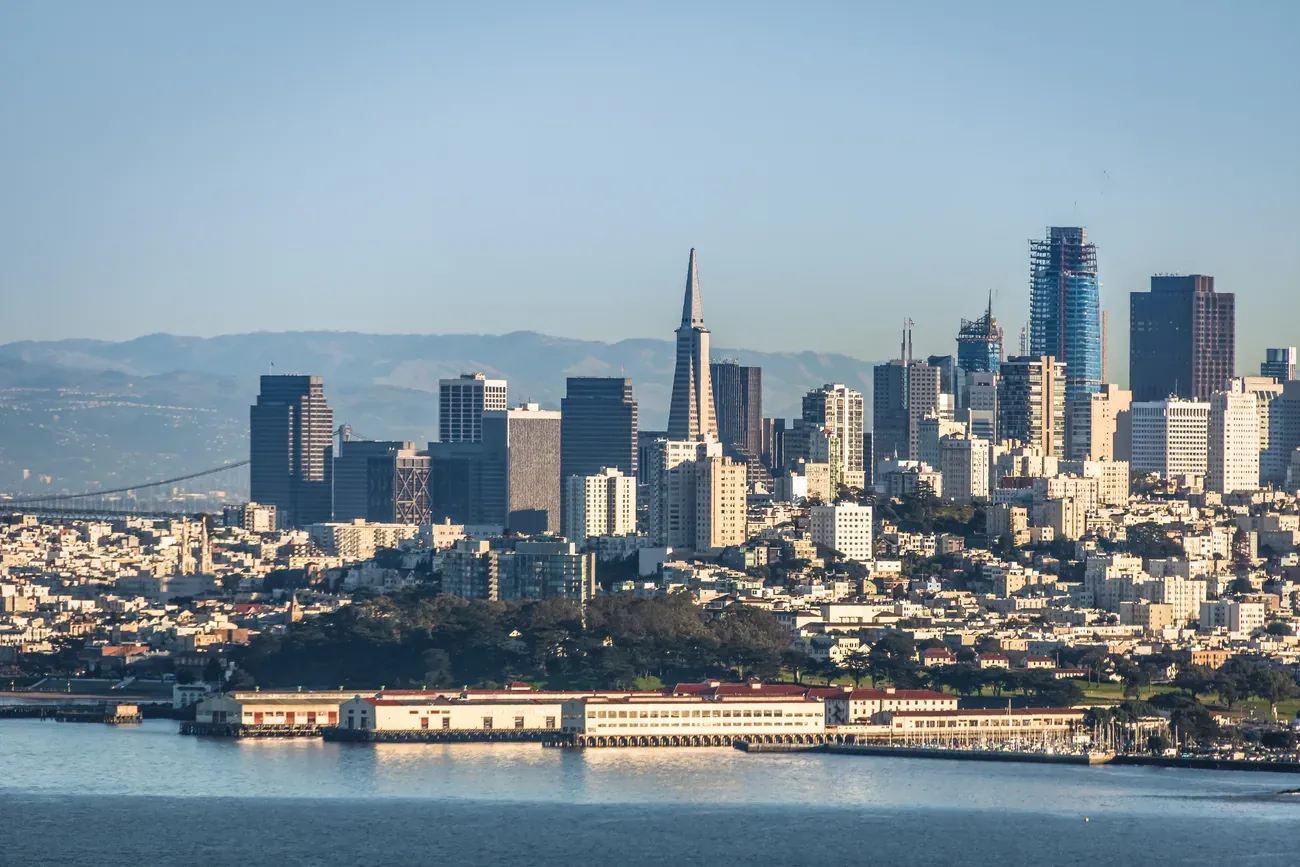
Union Square and the Financial District anchor downtown shopping and business; North Beach and Chinatown sit just north, the city's Italian and Chinese quarters. Fisherman's Wharf and Ghirardelli Square line the northern waterfront, while Russian Hill and Nob Hill climb steeply behind them with cable car lines and panoramic views. West of downtown, Haight-Ashbury keeps its 1960s counterculture streets, the Castro remains a historic centre of the city's LGBTQ community, and Golden Gate Park runs nearly to the Pacific shoreline.
When to go and how long to stay
Late September and October bring San Francisco's warmest, driest weather, after summer's coastal fog has mostly burned off. The National Park Service's San Francisco Maritime park warns that the city can turn foggy and windy at any time of year, so warm layers are worth packing in any month. Three to four days cover downtown, the waterfront and Golden Gate Park at an easy pace, with longer stays leaving room for Alcatraz, whose ferries are best booked well ahead, and day trips north across the bridge.
Getting around
Downtown, North Beach, Chinatown and Fisherman's Wharf form a walkable but hilly core, and three cable car lines, run by the SFMTA, connect Powell Street to Fisherman's Wharf and Nob Hill. Muni's buses, trains and the historic F-line streetcars reach the rest of the city, while BART links downtown to the airport and the wider Bay Area. Many hills are steep enough that a bus, streetcar or cable car beats walking, even over a short distance. The Golden Gate Bridge opened in 1937 and its east sidewalk costs nothing to walk, which keeps it on every shortlist of the top tourist attractions in the United States.