
Tourist attractions in Taipei
Known for
Steaming night markets, incense-filled temples and the skylines
Must-see landmarks
Taipei 101, Chiang Kai-shek Memorial Hall, and Lungshan Temple
Best time to visit
October and November, after typhoon season and before winter's rain
Days needed
Three to four days
The main tourist attractions in Taipei, ranked
For a first visit, the tourist attractions in Taipei come down to Taipei 101, Chiang Kai-shek Memorial Hall, Lungshan Temple and 7 more sights ranked below, plus free things to do and visitor FAQs.
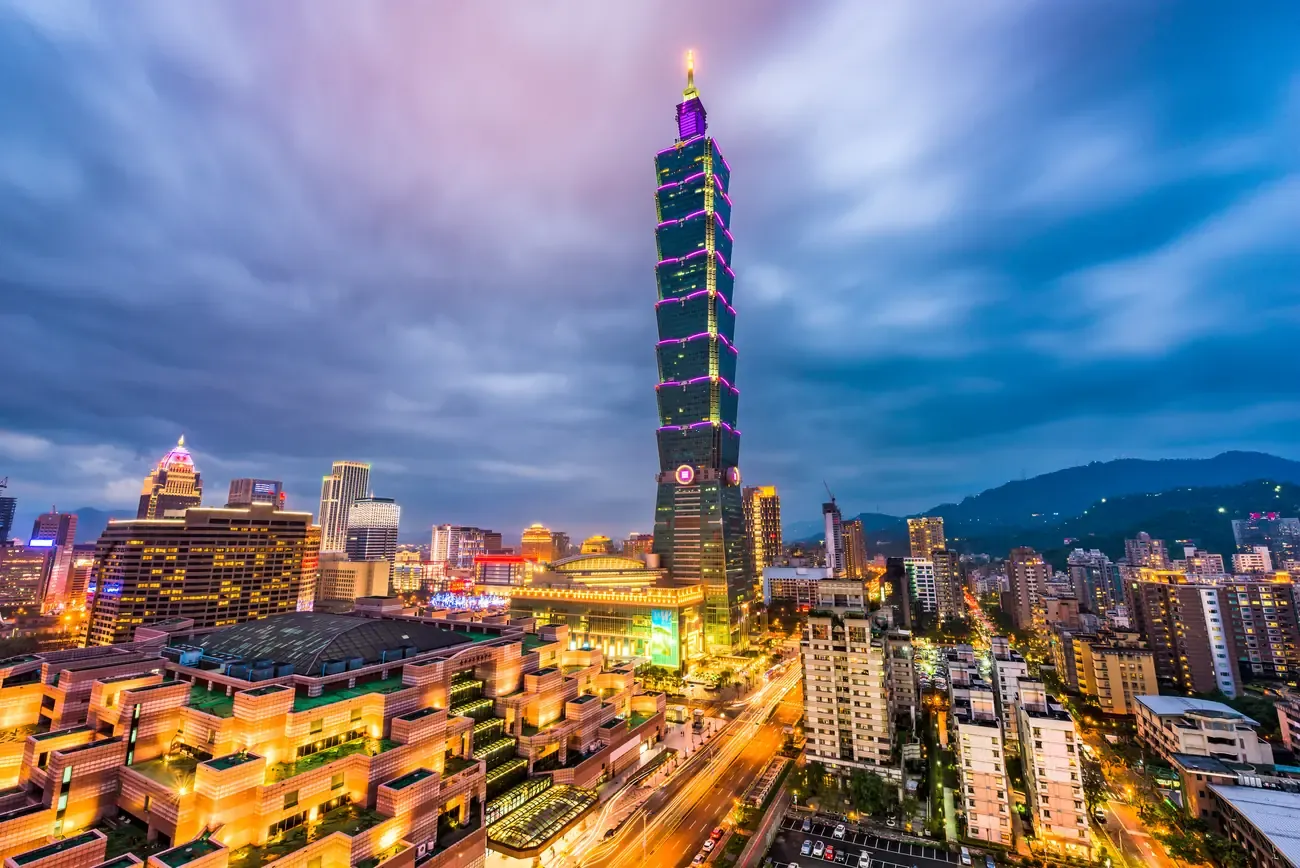
1. Taipei 101
The 101-storey tower has anchored the Xinyi skyline since 2004, its tapering, segmented profile built to resemble a stalk of bamboo. A giant tuned mass damper hung near the top, open to view, steadies the building against typhoons and earthquakes. The mall at its base is free to browse, while a separate ticket rides one of the world's fastest lifts to the 89th floor observatory, around 382 metres up, and on to the outdoor Skyline 460 deck above.
Architect: C. Y. Lee · Style: Postmodern
Location: Xinyi District, Taipei
Access: Ticketed observatory; the base mall is free to browse.
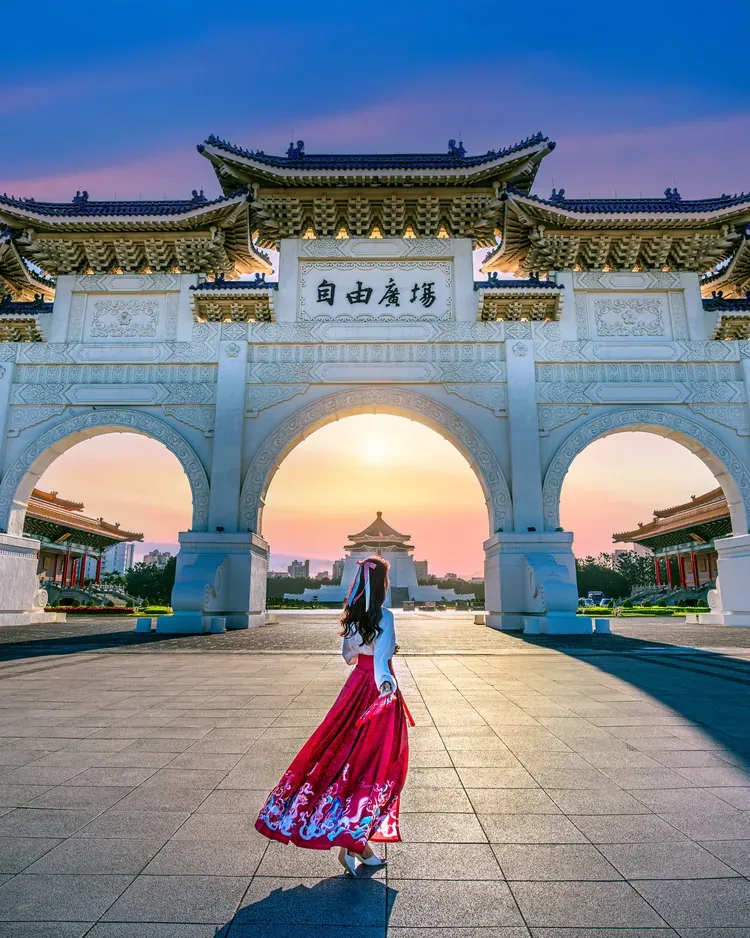
2. Chiang Kai-shek Memorial Hall
Completed in 1980, the white hall with its blue octagonal roof rises about 70 metres at the head of Liberty Square, reached by a broad flight of steps. Behind it spreads a park of some 25 hectares, with gardens, ponds and the National Theater and Concert Hall framing the plaza. A drill team performs an hourly changing of the guard on Democracy Boulevard, daily from 09:00 to 17:00, since the ceremony moved out of the statue room in July 2024.
Architect: Yang Cho-cheng · Completed: 1980
Location: Zhongzheng District, Taipei
Access: Free; the hall, park and permanent exhibition are open to all, with special exhibitions ticketed.
3. Lungshan Temple
Fujian settlers founded this temple in Wanhua in 1738 to honour Guanyin, the bodhisattva of mercy, and later halls brought in Mazu, Guan Yu and other folk deities under one roof. Rebuilt after fires, earthquakes and wartime bombing, its stone columns, swallowtail roofs and carved dragon pillars make it one of the city's finest works of temple craft. Worshippers fill the courtyards with incense, and students still pray at the rear hall to the god of literature before exams.
Founded: 1738 · Heritage: national historic monument
Location: Wanhua District, Taipei
Access: Free; the courtyards are open daily from 06:00 to 22:00.
4. National Palace Museum
One of the world's great collections of Chinese art fills this hillside museum in Shilin, north of the centre. Its holdings trace back to the imperial collection of the Forbidden City, carried to Taiwan in 1949 during the Chinese Civil War, and range from Neolithic jade and Shang bronzes to Song and Qing dynasty ceramics, painting and calligraphy. Only a fraction shows at a time, so the galleries rotate, and the carved jadeite cabbage draws a steady crowd.
Founded: 1925 · Opened in Taipei: 1965
Location: Shilin District, Taipei
Access: Ticketed; a single admission covers the permanent galleries.
Photos: the main building by Jirka Matousek (CC BY 2.0) and the museum lit at dusk by David097298 (CC BY-SA 4.0).
5. Elephant Mountain (Xiangshan)
A steep flight of steps climbs Xiangshan, the low peak just east of Xinyi, to the Six Giant Rocks, boulders that frame the classic view over Taipei 101 and the skyline below. The climb takes around fifteen minutes to the first platforms, and photographers line the rocks before sunset to watch the tower catch the evening light as the city switches on beneath it. The trailhead sits a short walk from Xiangshan metro station, at the end of the red line.
Location: Xinyi District, Taipei
Access: Free; the trail never closes, and dawn brings the quietest light for photos.
Photo: the Xiangshan trail up Elephant Mountain by dennis (CC BY-SA 2.0).
6. Shilin Night Market
The largest and best known of Taipei's night markets fills the lanes around Jiantan station every evening, spreading from a covered food hall into streets of clothing stalls, game arcades and dessert stands. Its kitchens are the draw, turning out oyster omelettes, giant fried chicken cutlets, stinky tofu and grilled squid to some of the biggest crowds in the city. The market traces its roots to 1913, and the after-dark ritual of grazing stall to stall has not changed.
Established: 1913
Location: Shilin District, Taipei
Access: Free to wander; only what is eaten or bought at the stalls carries a price.
Photos: the night market street by Junyu-K (CC BY-SA 4.0) and a tanghulu stall by Benlisquare (CC BY-SA 4.0).
7. Ximending
Taipei's pedestrianised youth quarter keeps its neon energy through a grid of covered arcades, boutiques, tattoo parlours and street food stalls near Ximen station. Laid out as an entertainment district under Japanese rule and still centred on the 1908 Red House theatre, it is now the city's hub for street fashion, cinema and live buskers. Cars are barred from the core lanes at weekends and on public holidays, when the main crossing fills with cosplay meet-ups and crowds.
Location: Wanhua District, Taipei
Access: Free; wandering the lanes costs nothing, and cars vanish from the core each weekend.
Photos: the Ximending shopping district near Ximen station by Lokseng01 (CC BY-SA 4.0).
8. Maokong Gondola
This cable car swings up from beside Taipei Zoo into the tea-growing hills of Maokong, climbing over forest and temple rooftops to the ridgeline tea houses at the top. The line runs in two sections with a turn near Zhinan Temple, and a limited number of Crystal Cabins have transparent glass floors for the view straight down. At the summit, tea houses serve the local Tieguanyin oolong grown on the surrounding slopes, with trails to viewpoints back over the city.
Opened: 2006
Location: Wenshan District, Taipei
Access: Ticketed; the gondola runs Tuesday to Sunday and closes on Mondays for maintenance.
Photos: a gondola cabin by Exec8 (CC BY-SA 4.0) and the Maokong tea terraces by lumoplank (CC0 1.0).
9. Beitou Thermal Valley
Steam drifts off a milky, jade-green pool at the head of the Beitou hot spring valley, where near-boiling sulphuric water rises from the ground and feeds the bathhouses downstream. A flat path of about fifteen minutes rings the water, once nicknamed Hell Valley for its heat and vapour, with boards explaining the green sulphur and the rare hokutolite mineral named after the district. Bathing is not allowed in the source pool, but the surrounding streets are lined with hot springs drawing on the same water.
Location: Beitou District, Taipei
Access: Free; open Tuesday to Sunday and closed on Mondays.
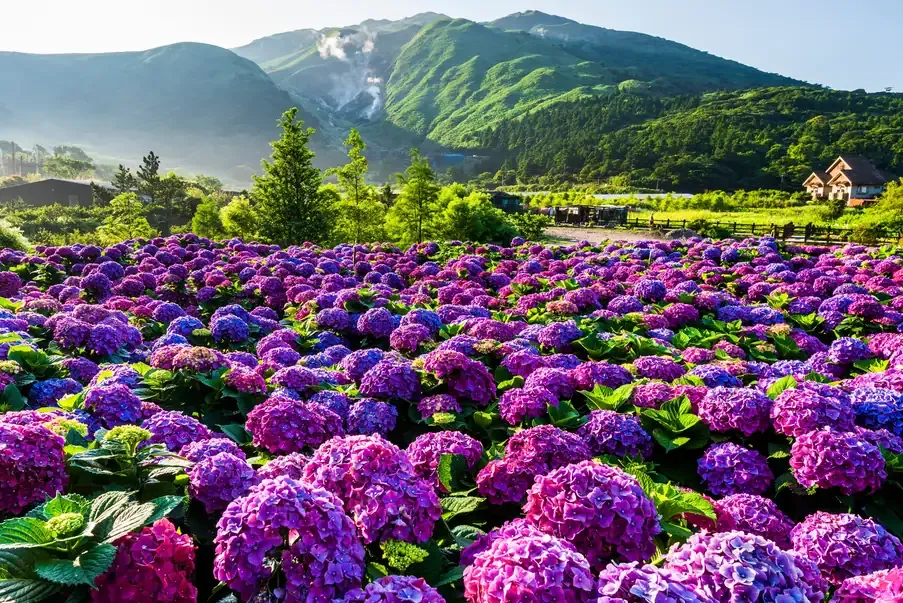
10. Yangmingshan National Park (day trip)
A short drive north of the city, this national park rings Taipei with dormant volcanic peaks, steaming sulphur vents and grassy ridges laced with hiking trails. Xiaoyoukeng's fumaroles hiss below Qixing Mountain, the park's highest point, while the Zhuzihu basin fills with terraced flower fields that turn blue, pink and purple when the hydrangeas bloom from around May. Hot spring streams and the Qingtiangang grassland spread across the slopes, an easy escape from the heat below.
Park established: 1985
Location: Beitou District, Taipei, extending into New Taipei
Access: Free to enter; some private flower farms at Zhuzihu charge their own admission.
Photo: the fumaroles of Yangmingshan by lumoplank (CC0 1.0).
What to do in Taipei for free
National Dr. Sun Yat-sen Memorial Hall
The exhibition halls and the plaza outside cost nothing to visit; ticketed performances inside the auditorium charge their own admission. Locals use the surrounding gardens for kite flying and evening dance practice at no cost.
Da'an Forest Park
This inner-city park is free and never gated, its ponds, lawns and jogging paths open around the clock for anyone passing through central Da'an.
228 Peace Memorial Park
The park of ponds, arched bridges and walking paths costs nothing to enter and stays open around the clock; the Taipei 228 Memorial Museum inside charges its own separate admission.
Beitou Hot Spring Museum
The restored 1913 bathhouse that gave Beitou's hot spring valley its start is free to tour, its Tudor-style hall and old soaking pool open to visitors at no charge; the newer public baths nearby charge their own fee.
Why Taipei is worth visiting
Taipei's character comes from layering, not from any single era. A Qing dynasty market town became Taiwan's provincial capital in 1887, was remade under five decades of Japanese rule after 1895, and was remade again after 1945 when the Kuomintang government relocated from mainland China and the city absorbed a wave of refugees. Temple courtyards, colonial era rail buildings and utilitarian postwar apartment blocks all still stand within a few minutes of each other, ringed by the volcanic hills of the Taipei Basin.
Neighbourhoods to know
Wanhua, one of the city's earliest settled districts, keeps Lungshan Temple and Ximending's pedestrian lanes. Zhongzheng holds the government quarter around Chiang Kai-shek Memorial Hall and 228 Peace Memorial Park. Datong's Dihua Street trades dried goods from old Qing era shopfronts, while glass towers rise around Taipei 101 in Xinyi. Shilin pairs the National Palace Museum with its night market, and Beitou's hot spring valley sits at the MRT network's northern end.
When to go and for how long
Autumn brings Taipei's driest, most comfortable weather, while the typhoon season runs from late spring into early autumn. Winters stay mild but grey and damp, and summer heat and humidity can feel far hotter than the thermometer shows. Three to four days cover the main temples, markets and viewpoints at an easy pace.
Getting around
The MRT network reaches almost every attraction in this guide. An EasyCard, tapped at gates rather than bought per ride, covers the metro and buses, and night markets and hillside trails all sit within a short ride of the centre. Taipei 101 was the tallest building in the world from 2004 to 2010, and the Taiwanese capital makes an easy add-on to any list of tourist attractions to see in Asia.