

Berlin tourist tax, the 7.5% city tax on hotels and rentals
Berlin charges a tourist tax, called the city tax or Übernachtungsteuer, on paid overnight stays in hotels, hostels and holiday rentals. It is 7.5% of the room price before VAT and extras, on every night of a stay under six months. Business trips pay too.
Photo: "Berlin Hauptbahnhof and Washingtonplatz Berlin-Moabit 2025-12-09 01" by Leonhard Lenz (CC0).
How much the Berlin city tax is
The Berlin city tax is 7.5% of what a guest pays for the room, counted without VAT and without other services such as breakfast. In German it is the Übernachtungsteuer, often spelled Übernachtungssteuer and known as the Bettensteuer, or bed tax. It is charged on the room rather than per person, so two guests sharing a room do not pay it twice. The Berlin city tax service page (in German) sums up the rules, and the Berlin Übernachtungsteuer law (in German) sets them out in full.
| Berlin city tax at a glance | Rule in 2026 |
|---|---|
| Rate | 7.5% of the taxable price, with no minimum, maximum or rounding rule |
| Taxable price | The room price without VAT and without other services |
| Not taxed when billed separately | Breakfast and other meals, minibar, parking, wifi and wellness |
| Nights | Every night of a stay offered for less than six months |
| Who owes it | The hotel, hostel or host, which passes it on to the guest |
| Business trips | Taxed since 1 April 2024 |
| Current rate since | 1 January 2025, up from 5% |
The tax is run by one tax office for the whole city, the Finanzamt Marzahn-Hellersdorf, and the Senate Department for Finance city tax FAQ (in German) lists the changes made since 2024. Questions about a bill go first to the hotel or host, and the Berlin tourist information offices help with everything else on arrival.
For the rest of the trip, the guide to things to do in Berlin covers the sights worth the time, from the Brandenburg Gate and Museum Island to the East Side Gallery.
What the city tax adds to a hotel stay
Room rates in Germany include 7% VAT, so the tax is the room price divided by 1.07 and multiplied by 7.5%. That comes to just over 7% of the price paid for the room. A rate that includes breakfast is worked out on the room part only: on a €150 rate with a €15 breakfast, the tax is charged on €135 and comes to €9.46.
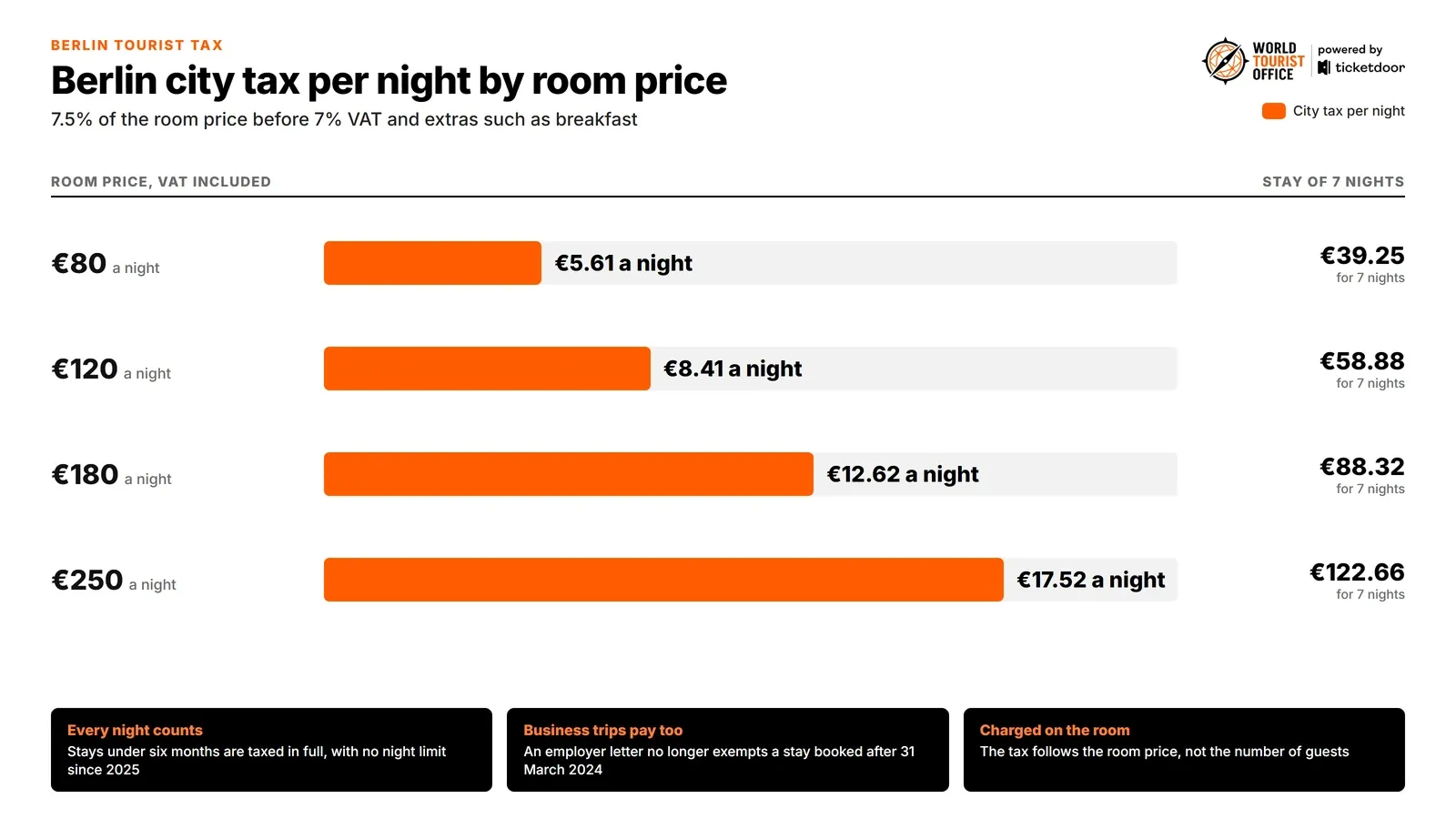
| Room price per night, VAT included | City tax per night | City tax for 7 nights |
|---|---|---|
| €80.00 | €5.61 | €39.25 |
| €120.00 | €8.41 | €58.88 |
| €180.00 | €12.62 | €88.32 |
| €250.00 | €17.52 | €122.66 |
The figures are per room, not per person, so a couple in a €120 room pays €8.41 a night between them. Cleaning, bed linen or an extra bed billed on top of the room count towards the taxable price, while parking or a spa visit do not.
Who pays and how it shows on the bill
Under section 2 of the law, the accommodation owes the tax to the tax office and passes it on to the guest. That covers hotels, guesthouses, hostels, youth hostels, holiday apartments and rooms in private homes, including those let by private hosts. The law does not say whether the tax is collected at check-in or at check-out. Since April 2024 it no longer requires the tax to appear on the invoice, although many hotels still list it as a separate line.
The tax arises once the room is paid for. A paid no-show is taxed, because Berlin taxes the paid right to a room whether or not anyone sleeps in it, and so is a day-use room paid for a few hours.
| How the stay was booked | How the city tax is handled |
|---|---|
| Directly with a hotel or on its website | Included in the rate, charged to the card on arrival or added at the desk, depending on the hotel |
| Booking.com | The price breakdown says whether the city tax is included; if it is excluded, the property collects it |
| Airbnb | Not collected at booking: Airbnb's list of German cities where it collects the tax names Dresden, Dortmund, Frankfurt and Wiesbaden, not Berlin |
| Vrbo | Not collected at booking: Vrbo's list of European stay taxes it collects includes no German city |
On Airbnb and Vrbo the host owes the tax. Some hosts add it to the listing, where Airbnb shows it under Taxes in the price breakdown, and others ask for it separately. Berlin's districts pass the details of licensed holiday apartments to the tax office every year.
Business trips have paid the city tax since April 2024
From 2014 to March 2024, a guest travelling for work did not pay the Berlin tax after showing the hotel proof of the work purpose, usually a letter from the employer. The Federal Constitutional Court ruling of 22 March 2022 (in German) found that a local tax on overnight stays may also cover stays for work. After that ruling, the Senate decision of 19 December 2023 (in German) dropped the exemption, and the amending law of 29 February 2024 (in German) taxed business stays from 1 April 2024.
Since then a conference, a client visit and a holiday pay the same tax. The employer certificate and the self-certification form are still listed among the Senate's downloads, but they only apply to bookings that were binding before 1 April 2024. Many travel pages and some hotel pages still describe the old exemption.
Long stays, apartments and the six month rule
Until the end of 2024, Berlin stopped charging the tax after 21 nights in a row at the same place. The Senate bill that ended the 21 night limit (in German) pointed to apartment rentals and rooms let to tradespeople, and since 1 January 2025 there is no limit at all. Instead, the law taxes any accommodation offered for less than six months, for every night of the stay.
| Stay | Price, VAT included | City tax |
|---|---|---|
| Two weeks in a holiday apartment | €90 a night | €88.32 |
| One month in an aparthotel | €70 a night | €147.20 |
| Three months in a furnished flat | €1,400 a month | €294.39 |
| Rental agreed for six months or more | Any | None |
An apartment let for six months or longer is not short-term accommodation under the law, so no city tax is due. What counts is the length of the rental, not how many nights the guest actually spends there.
Who does not pay the city tax in Berlin
The Berlin law lists no exemptions, and it has none by age or for Berlin residents. The cases below come from the tax administration's guidance, as quoted in answers from the Senate Department for Finance that the hotel association DEHOGA Berlin published in 2024. That guidance treats stays that meet basic needs, such as housing or medical care, as outside the tax.
| Situation | City tax | What to show |
|---|---|---|
| School pupils on a school trip | Not charged | School certificate, also available in English |
| Teachers on a school trip | Charged | Nothing |
| Patients staying for medical reasons, and a companion whose care is needed | Not charged | Agreed with the accommodation |
| Homeless people and asylum seekers housed by the authorities | Not charged | Arranged by the authorities |
| Diplomats exempt from local taxes | Not charged | Diplomatic status |
| University study trips | Charged | Nothing |
| Trips organised by clubs and associations | Charged | Nothing |
| Language courses with accommodation | Charged on the room part | Nothing |
| Business trips | Charged | Nothing |
| Children and teenagers outside school trips | Charged | Nothing |
The school certificate and the other forms are on the Senate Department for Finance forms page (in German). Hotels apply this guidance case by case, so a guest who expects not to pay should raise it with the accommodation before arrival.
Hotels at BER airport and around Berlin
Sleeping just outside the city no longer avoids the tax. The municipality of Schönefeld, home to the BER terminals and Airport City, has charged its own overnight tax of 7.5% since 1 January 2026, as the Schönefeld overnight tax page (in German) explains. Potsdam charges the same rate under the Potsdam overnight tax bylaw (in German).
| Place | Berlin |
|---|---|
| Rate | 7.5% of the price before VAT |
| Since | 1 January 2025 |
| Children | Pay |
| Business trips | Pay |
| Place | Schönefeld, BER terminals and Airport City |
|---|---|
| Rate | 7.5% of the price before VAT |
| Since | 1 January 2026 |
| Children | Exempt under 16 |
| Business trips | Pay |
| Place | Potsdam |
|---|---|
| Rate | 7.5% of the price before VAT |
| Since | 1 April 2025, tax since 2014 |
| Children | Exempt under 18 |
| Business trips | Pay |
The hotel's address shows which tax applies. Some hotels sold as BER airport hotels stand on Berlin soil, in Bohnsdorf, and charge the Berlin tax, which has no exemption for children.
City tax, VAT and tax-free shopping
Three different charges get mixed up on Berlin bills. The city tax is 7.5% of the room price and goes to the State of Berlin. VAT on accommodation in Germany is 7%, a federal tax already included in the room rate, and the city tax is worked out on the price without it.
Tax-free shopping is something else again. Visitors from outside the EU can reclaim VAT on goods they take home, with export papers stamped by customs at departure. That refund covers shopping only, not hotel stays and not the city tax.
How the Berlin city tax has changed since 2014
Many websites still quote 5%, a 21 night limit and an exemption for business trips. All three were true when the tax began in 2014 and changed in 2024 and 2025. The amending law of 20 December 2024 (in German) raised the rate to 7.5% from 2025 and moved hotels to quarterly returns from 2026. Stays booked with a binding contract before 1 January 2025 still pay 5%, even when they take place later.
| Date | Change |
|---|---|
| 1 January 2014 | The tax starts at 5% of the room price before VAT; business trips exempt; tax stops after 21 nights in a row |
| 22 March 2022 | The Federal Constitutional Court rules that business stays can be taxed |
| 1 April 2024 | Business trips taxed; employer certificates and the refund procedure end |
| 1 January 2025 | Rate rises to 7.5%; the 21 night limit ends; stays under six months taxed in full |
| 1 January 2026 | Hotels file quarterly and online; the rate does not change |
The tax brought in €58.7 million in 2023, €89.6 million in 2024 and €150.35 million in 2025, according to the Berlin tax revenue figures for 2025 (in German). The law does not tie the money to any purpose, so it goes into the general budget. As of 29 October 2026 no change for 2027 has been approved.