
Tourist attractions in Seville
Known for
Flamenco, tapas bars and Moorish-Mudejar landmarks
Must-see landmarks
Real Alcazar, Seville Cathedral, Plaza de Espana and Metropol Parasol
Best time to visit
Spring and autumn: summer afternoons regularly pass 35°C
UNESCO World Heritage
Cathedral, Real Alcazar and Archivo de Indias, listed since 1987
The main tourist attractions in Seville, ranked
Here are the tourist attractions in Seville worth planning around, starting with Real Alcazar, Seville Cathedral and La Giralda and Plaza de Espana. The 10 top sights come first, then free things to do, upcoming events and visitor FAQs.
1. Real Alcazar
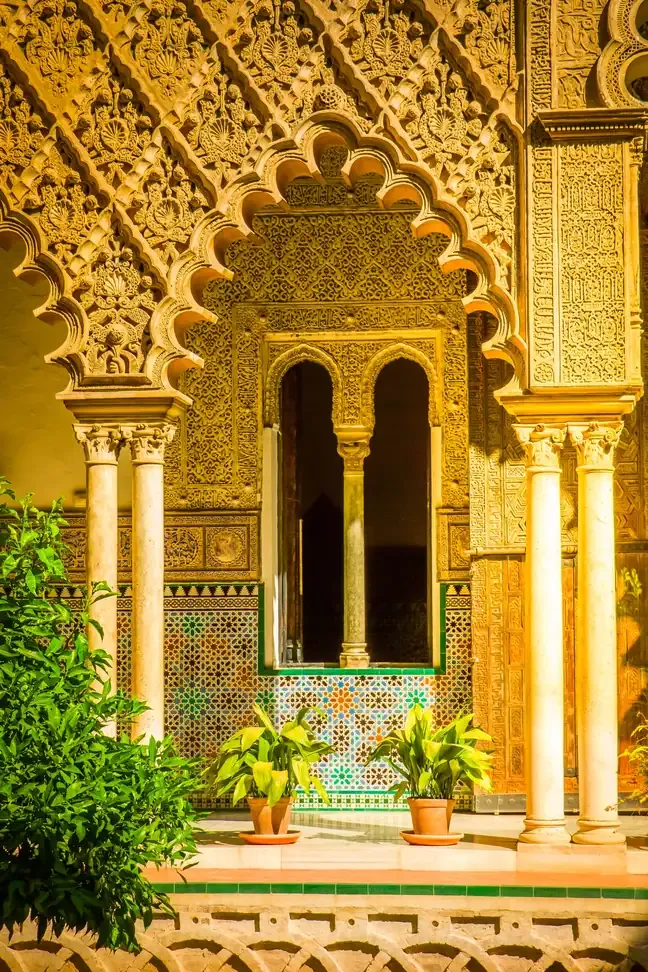
The Real Alcazar has been a royal seat since Ferdinand III took the city in 1248, and its heart is the Mudejar Palace raised for King Pedro I around 1364, where carved stucco, horseshoe arches and glazed tiles frame the Patio de las Doncellas. Older Almohad courts, Gothic halls and the sunken Baths of Dona Maria de Padilla open off it, while gardens of orange trees, pools and pavilions run behind. The upper floors still serve the Spanish royal family, keeping it among the oldest palaces in Europe in continuous royal use.
Style: Mudejar
Heritage: UNESCO World Heritage Site
Location: Patio de Banderas, Seville
Access: Ticketed, with timed entry to the palace and gardens.
2. Seville Cathedral and La Giralda
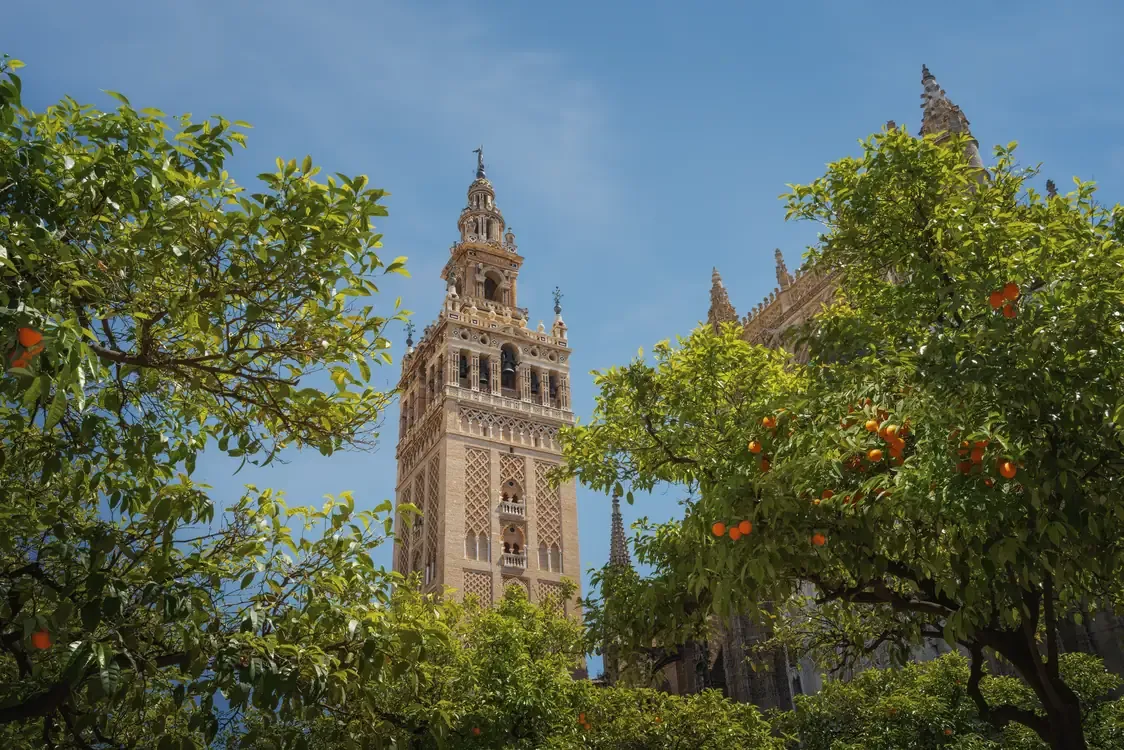
Seville Cathedral rose on the site of the city's former Great Mosque after the canons resolved to build anew in 1401, and the vast Gothic church was inaugurated in 1507. Its own site calls it the largest Gothic cathedral in the world, and the tomb of Christopher Columbus stands inside, carried by four heralds of the old kingdoms of Spain. La Giralda, the mosque's former minaret turned bell tower, rises beside it and is climbed by ramps rather than stairs, giving wide views over the rooftops of the old town.
Style: Gothic
Heritage: UNESCO World Heritage Site
Location: Avenida de la Constitucion, Seville
Access: Ticketed, covering the cathedral and the climb up La Giralda.
3. Plaza de Espana
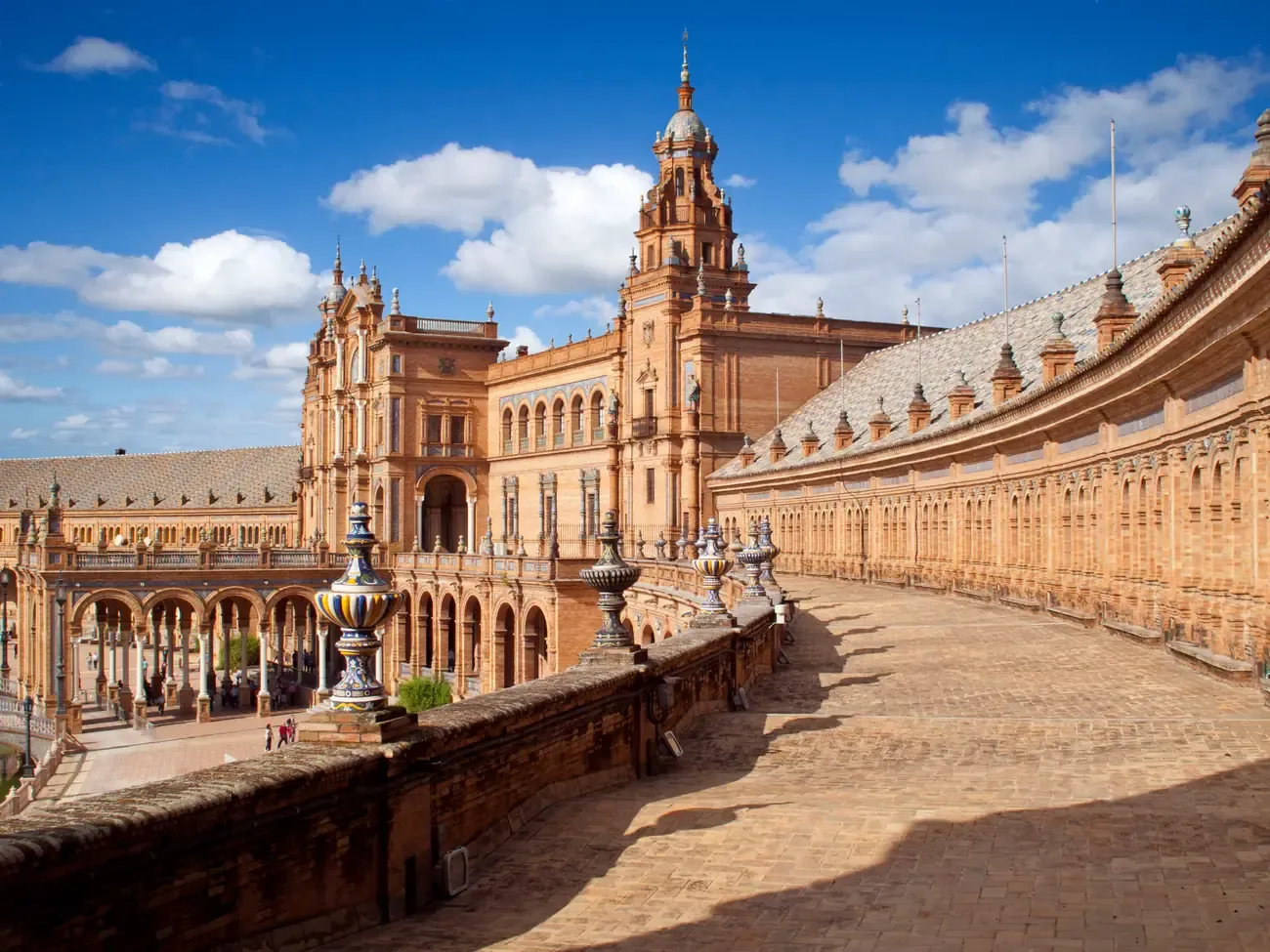
Architect Anibal Gonzalez raised this vast half-circle of brick and tile for the 1929 Ibero-American Exposition, edging it with a canal crossed by four bridges that stand for the ancient kingdoms of Spain. The curving facade is lined with tiled alcoves, one for each Spanish province, each set with a painted scene and a map. Rowing boats drift along the moat-like water below the twin towers, and the whole square sits at the edge of the Parque de Maria Luisa, a short walk from the river.
Architect: Anibal Gonzalez
Style: Regionalism
Location: Parque de Maria Luisa, Seville
Access: Free to enter as an open public square.
4. Metropol Parasol
The Metropol Parasol, known to locals as Las Setas, the mushrooms, is a honeycomb of timber canopies that opened in 2011 to a design by architect Jurgen Mayer H., billed by its operator as the largest wooden structure in the world. It rises over Plaza de la Encarnacion on concrete piers, and a lift carries visitors to a winding rooftop walkway with long views across the old town toward the cathedral. Beneath it, a small museum, the Antiquarium, protects Roman and Moorish remains uncovered when the site was dug.
Architect: Jurgen Mayer H.
Location: Plaza de la Encarnacion, Seville
Access: The plaza below is free at any hour; the rooftop walkway is ticketed.
Photo: "Setas de Sevilla" by Anual (CC BY-SA 4.0).
5. Torre del Oro
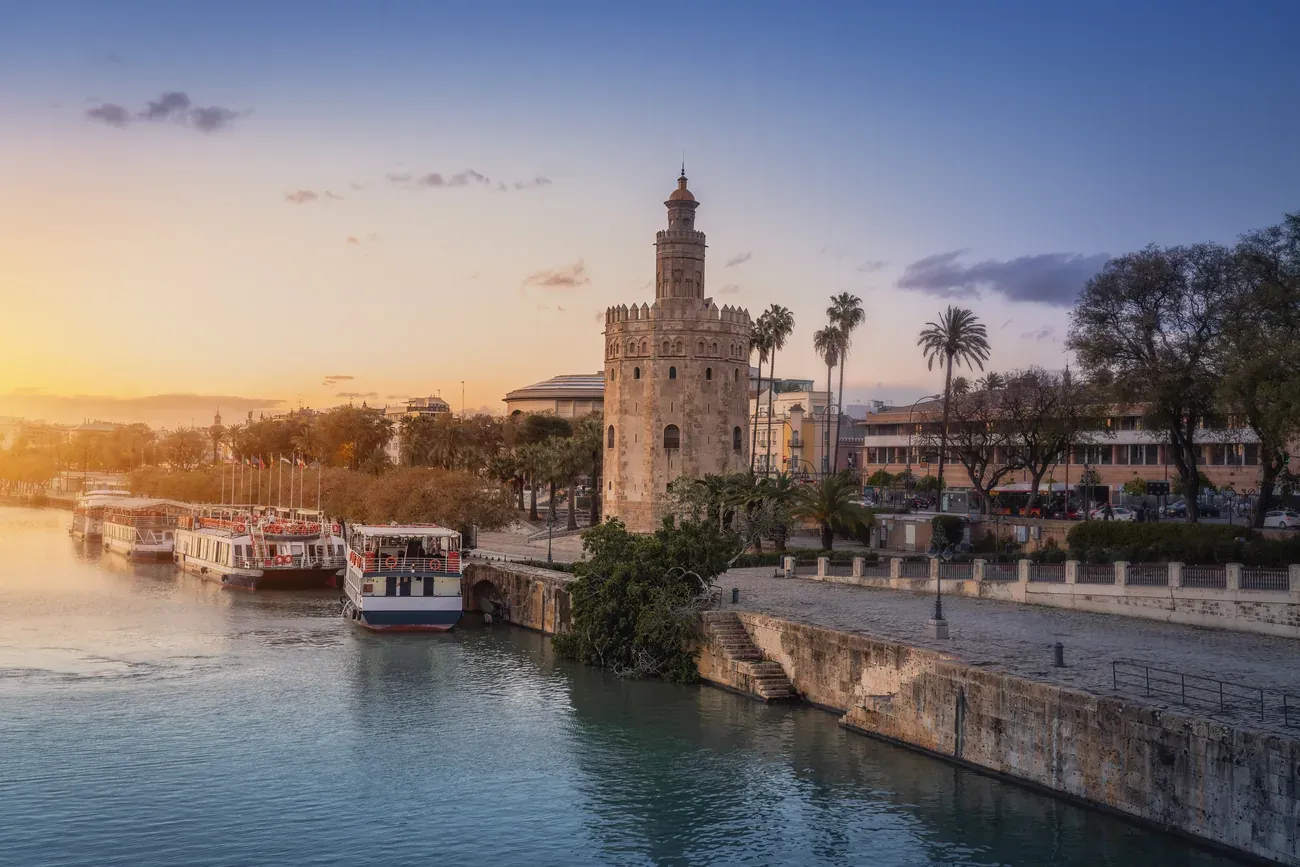
This twelve-sided defensive tower on the bank of the Guadalquivir was built around 1220 by Abu-l-Ula, the city's last Almohad governor, and once anchored a great chain that could be drawn across the river to bar enemy ships from the port. The name, Tower of Gold, is often traced to golden tiles or to the glow of its stone on the water. Standing about thirty-six metres tall, it now holds a small naval museum, with a viewpoint at the top over the river and the bullring nearby.
Style: Almohad
Location: Paseo de Cristobal Colon, Seville
Access: Ticketed, with a small naval museum and a rooftop viewpoint.
Photo: "Torre del Oro and the river Guadalquivir" by Benjamin Smith (CC BY-SA 4.0).
6. Barrio Santa Cruz
The Barrio de Santa Cruz was the city's Jewish quarter until the expulsions of the late Middle Ages, and its tangle of narrow, whitewashed lanes still forms the most atmospheric corner of old Seville. Streets barely wide enough for two people open without warning onto small squares such as Plaza de Santa Cruz and Plaza de Dona Elvira, their balconies strung with geraniums and their orange trees casting shade over the cobbles. The quarter presses right up against the walls of the Real Alcazar and the cathedral.
Location: East of the Cathedral, Seville
Access: Free to wander at any hour; quietest in the early morning.
Photos: "Barrio de Santa Cruz, Seville" by Harvey Barrison (CC BY-SA 2.0); "Santa Cruz, Seville" by Vanbasten 23 (CC BY-SA 3.0).
7. Plaza de Toros de la Real Maestranza
The Real Maestranza is one of the oldest bullrings in Spain, built in stages from the middle of the 18th century into the 19th on the Baratillo, a low rise above the Guadalquivir. Its Baroque Prince's Gate and whitewashed, ochre-trimmed arcades give the ring an irregular, curving plan rather than a true circle, and it stands among the most visited monuments in the city. A guided tour takes in the ring, the stands and the Museo Taurino, whose collection traces the building's long history.
Style: Baroque
Location: Paseo de Cristobal Colon, Seville
Access: Ticketed guided tours of the ring and museum, with closures on event days.
Photos: "Plaza de Toros de la Maestranza" by Vincenzo Venditti (CC BY-SA 3.0 ES); "Plaza de toros de la Maestranza" by Alberto-g-rovi (CC BY 4.0).
8. Archivo General de Indias
The Archivo General de Indias holds the paperwork of Spain's empire in the Americas, shelved along kilometres of racks inside the 16th century Lonja de Mercaderes, the old merchants' exchange designed by Juan de Herrera. King Charles III turned the building into a single archive in 1785 to gather records once scattered across the country, and today it keeps charts, letters and decrees signed by figures such as Columbus and Cervantes. Together with the cathedral and the Real Alcazar it has formed one UNESCO World Heritage Site since 1987.
Architect: Juan de Herrera
Heritage: UNESCO World Heritage Site
Location: Avenida de la Constitucion, Seville
Access: Free admission to the exhibition rooms.
Photos: "Archivo General de Indias, Seville" by Kordas (CC BY-SA 4.0); "Archivo General de Indias, Seville" by José L. Filpo (CC BY 3.0).
9. Casa de Pilatos
The Casa de Pilatos is the grandest private palace in Seville, built for the Enriquez de Ribera family across the 15th and 16th centuries and named for a supposed likeness to the house of Pontius Pilate in Jerusalem. It blends late Gothic and Mudejar craft with the early Renaissance ideas its owners brought back from Italy, seen in the central courtyard where azulejo tiles, delicate plasterwork and classical statues meet under arcades. Quiet gardens and painted ceilings fill the rooms beyond, and the House of Medinaceli still owns it.
Style: Mudejar and Renaissance
Location: Plaza de Pilatos, Seville
Access: Ticketed, open to visitors daily.
Photos: "Patio de la Casa de Pilatos, Seville" by Jl FilpoC (CC BY-SA 4.0); "Casa de Pilatos, Seville" by Anual (CC BY-SA 4.0).
10. Parque de Maria Luisa
Infanta Maria Luisa Fernanda gave part of the gardens of her San Telmo Palace to the city in 1893, and the landscape architect Jean-Claude Nicolas Forestier reshaped the grounds for the 1929 exposition, opening the finished park in 1914. Shaded paths wind between tiled fountains, palm groves, ponds and hidden glorietas, among them the monument to the poet Becquer and the ceramic benches of the Plaza de America. It is the green heart of the city, the natural place to end a day of walking near the river.
Landscape architect: Jean-Claude Nicolas Forestier
Location: Avenida de Maria Luisa, Seville
Access: Free to enter as a public park, open daily.
Photo: "Pabellón Mudéjar, Parque de María Luisa" by Jocelyn Erskine-Kellie (CC BY-SA 2.0).
Upcoming events in Seville
Candlelight: Tributo a Joan Manuel Serrat
Candlelight: Tributo a Joan Manuel Serrat comes to Global Omnium Auditorio on 7 November at 19:00.

La Impro Verbena
La Impro Verbena comes to La Sala - Sevilla on 7 November at 21:00.

Kidd Voodoo
Kidd Voodoo plays Pandora Sevilla on 15 November at 20:00. · Sold out

Metrika
Metrika plays Pandora Sevilla on 4 February 2027 at 21:00.
Michael Foster
Michael Foster plays Sala Malandar on 20 February 2027 at 21:30.
Free landmarks and viewpoints in Seville
Triana
Triana's riverside promenade and its weekend flea market cost nothing to browse; a handful of ceramics workshops charge only for hands-on painting classes, not for a look inside.
Puente de Isabel II
Completed in 1852 as Seville's first permanent metal bridge, Puente de Isabel II is open to pedestrians around the clock at no cost, with river views back toward Torre del Oro.
Jardines de Murillo
These shaded public gardens along the old city wall, just outside Barrio Santa Cruz, are free to enter and make a quiet spot to rest between the Alcazar and the cathedral.
Alameda de Hercules
This long, tree-lined square north of the centre costs nothing to stroll, ringed by bars and cafe terraces that fill up as the evening cools down.
Why visit Seville
Seville curves along the Guadalquivir as the capital of Andalusia, a city built on Roman foundations, reshaped under Muslim rule and then again after the Christian conquest of 1248. Flamenco, tapas and a skyline anchored by the Giralda and the turrets of the Real Alcazar give the old town a rhythm that rewards slow walking as much as any single monument.
Neighbourhoods to know
Barrio Santa Cruz, the old Jewish quarter east of the cathedral, keeps the tightest tangle of lanes and courtyards in the city. Triana, across the Isabel II bridge, grew up around sailors and potters and still smells of the kilns along Calle Alfareria. North of the centre, Alameda de Hercules mixes 16th century columns with a livelier bar scene, while the streets around Casa de Pilatos and Palacio de las Duenas hold some of Seville's grandest private courtyards.
When to go and how long to stay
Spring and autumn keep the old town's stone streets comfortable; summer afternoons regularly pass 35°C, with July's average high at 36°C according to AEMET, Spain's meteorological agency. A single day covers the cathedral, the Alcazar and the walk down to Plaza de Espana, while a second allows Triana, the Archivo de Indias and the smaller palaces. Two of the city's biggest events move with the lunar calendar: in 2027, Semana Santa runs from Palm Sunday on 21 March to Easter Sunday on 28 March, and the Feria de Abril follows roughly two weeks later, from 13 to 18 April.
Getting around and beyond
The old town is compact and flat enough to cover on foot, with trams and buses filling in for longer hops. The EA airport bus links Sevilla Airport's terminal directly to Plaza de Armas in the centre; the metro does not reach the airport. High speed AVE trains connect Seville directly to Madrid and to Granada, while Cordoba makes an easy day trip by the same line. Closer to the city, a short drive of around 13 km reaches the Roman ruins of Italica in the village of Santiponce, founded by Scipio Africanus in 206 BC and later the birthplace of the emperors Trajan and Hadrian. The cathedral and the Real Alcazar, listed together by UNESCO in 1987, keep Seville near the front of any list of tourist attractions to see in Spain.